Pipeline CRM
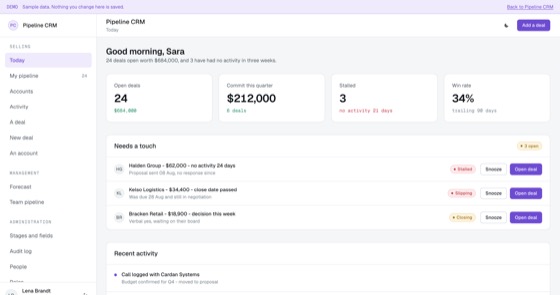
Deal stages, forecasting and activity history for a sales team that has outgrown a spreadsheet.
5.0 out of 511 sold
Programme overviewProgramme manager1 / 8
4.0 out of 53 sold
Give every partner their own login, their own deal register and their own scorecard, without giving them a seat in your internal CRM, and without the programme living in a spreadsheet only one person understands.
From$549
Inside the app
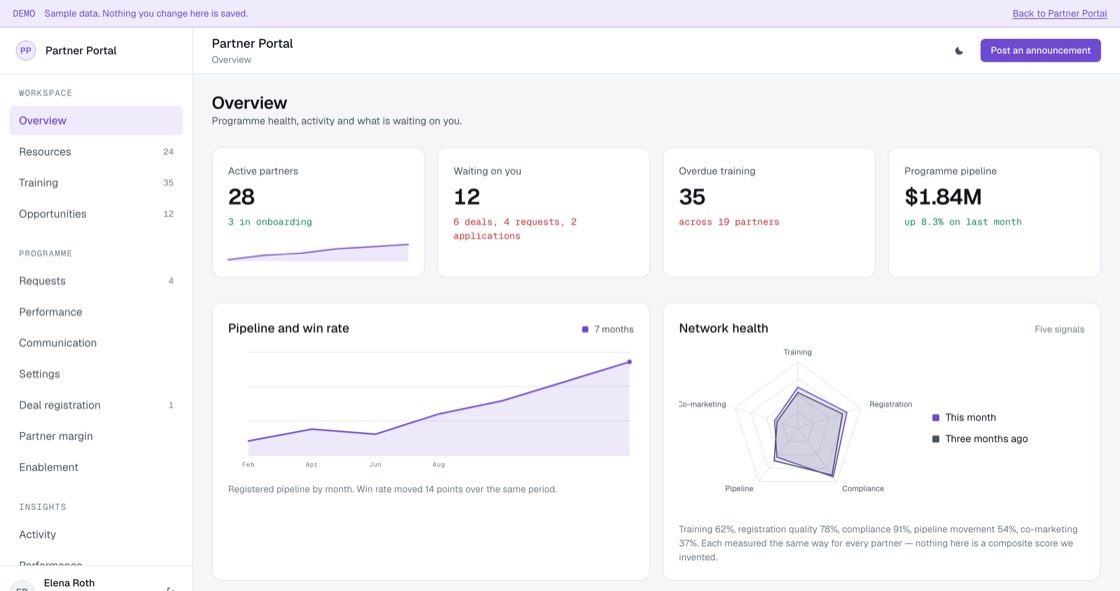
28 connected functions on one schema, spanning two sides of the same programme. Everything below is in the template before a line of customisation.
Active partners, what is waiting on you and for how long, overdue training, and pipeline. A queue is the honest measure of a partner programme.
Every registration across every partner, by stage, with the end customer named. Approving one is a dated commitment not to compete on it.
A library with folders and tier entitlement, so Gold sees enterprise pricing and Registered does not. Download counts are per partner.
Modules, mandatory or optional, with completion across the network and a named overdue list. Mandatory means it blocks registration, or it means nothing.
Market development funds, co-sell support and technical questions in one queue, with a decision target and a reason recorded either way.
Win rate, pipeline by stage and a leaderboard ranked by value won rather than pipeline, because pipeline is a forecast and won is a fact.
Announcements addressed to a tier, with read counts per partner, and a notification list that says what changed rather than that something did.
Thresholds, protection windows, funding caps and decision targets. Moving a threshold does not retroactively demote anybody.
The partner opens on their tier, their points to the next one, their pipeline and what is due from them. Overdue mandatory training is stated, not discovered.
The partner registers, sees the stage and the date it changed, and gets a reason when it is rejected. Approved deals show their protection expiry.
Assigned modules with certificates that stay on the record, and funding requests against a cap the partner can see.
The same five signals the programme manager sees, because a partner ranked on numbers they cannot see will not trust the ranking.
Permissions
A partner portal only works if partners log in, so the partner side is a real application rather than a document drop. Both sides run on one schema, and partner records are isolated at the row level rather than by hiding buttons.
The build
20 screens, all of them live in the preview. Nothing on this list is a mockup or a roadmap item.
Access
Programme side
Partner side
Throughout
What you get
Companies selling through resellers, agencies or referral partners who currently run the channel over email.
Access and evidence
A channel dies the day a partner believes a deal was taken from them. Deal protection, duplicate checks and the scorecard a tier is decided on are therefore visible to both sides, from the same record, with every decision logged.
Related
Deal stages, forecasting and activity history for a sales team that has outgrown a spreadsheet.
5.0 out of 511 sold
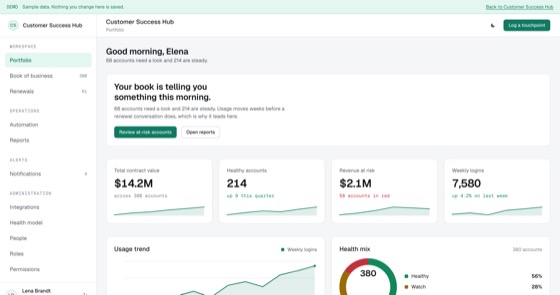
Health scores, renewal calendars and QBR prep for the team that keeps revenue from leaking.
4.5 out of 56 sold
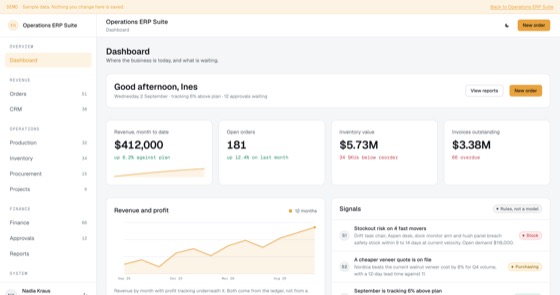
The full ERP spine: orders, CRM, production, stock, purchasing, projects, finance, approvals, reporting, people and automation.
5.0 out of 58 sold
Questions
Not covered here?
Ask a consultant directly. No form to fill in first, and no follow-up sequence.
Book a consultantAll questionsYes. The repository, application code, database schema, migrations, seed data and deployment configuration, is transferred to your organisation on delivery. There is no licence key and nothing that calls home.
As many as you like. Pricing is per application, not per partner or per seat, so onboarding your hundredth reseller costs exactly the same as onboarding your first.
Registration gives the partner exclusivity on that customer for a fixed window, 90 days by default, extendable once by a channel manager. Every submission runs a duplicate check against the direct pipeline, and a conflict is routed to a person rather than being auto-rejected, because a silent rejection is how you lose a partner.
No. Partner records are isolated at the database row level, not by hiding buttons, so a partner account cannot reach another partner's pipeline, requests or documents even by manipulating a URL.
That is the usual route. A fitted build adjusts tier names and thresholds, funding caps, protection windows, training requirements, branding and up to two integrations, and typically takes one to three weeks from a signed scope.
Hosting only, paid to your own cloud provider, roughly $50 to $200 a month depending on partner count and asset storage. There is no recurring fee to us unless you choose managed hosting.
Start here
A fitted build adjusts fields, stages, roles and integrations to how your team already works. One scoping call, a fixed price, one to three weeks.