Inventory Control
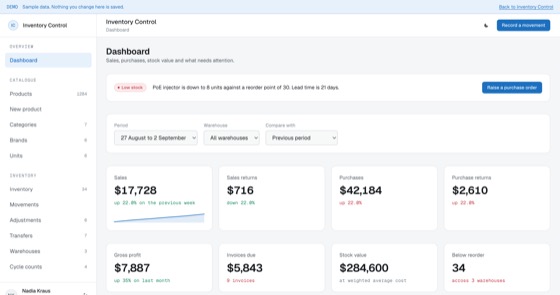
Catalogue, stock, warehouses, purchase orders, suppliers, sales, cycle counts and valuation, on one append-only movement ledger.
5.0 out of 510 sold
DashboardAdmin1 / 8
5.0 out of 58 sold
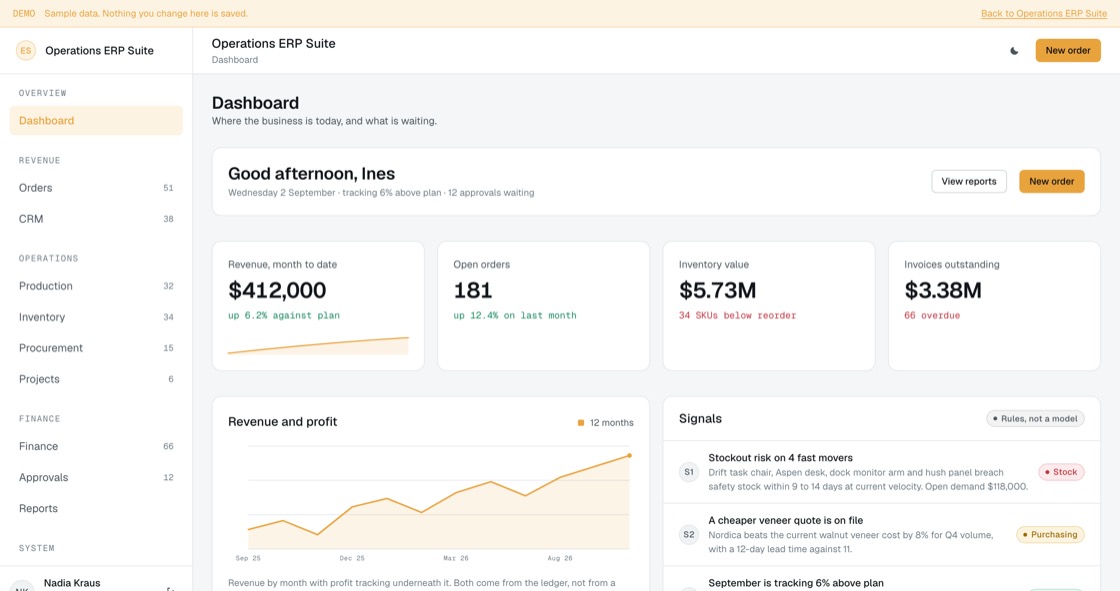
Twenty-four functions covering the operational spine of a product business, revenue, production, stock, purchasing, projects, finance, people and the automation between them, wired to one schema so stock, orders and ledger never disagree.
From$899
Inside the app
24 connected functions on one schema, spanning three permission levels. Everything below is in the template before a line of customisation.
Revenue against plan, open orders, inventory value and outstanding invoices, with a twelve-month revenue and profit line drawn from the ledger rather than a reporting copy.
Stockout risk, a cheaper supplier quote, a run rate ahead of plan, each one a threshold rule over your own data with the arithmetic shown. Nothing generated.
Sales, purchase, work orders, returns and shipments in one place. Promised is the date the customer was given, kept separate from the date operations would prefer.
Pipeline, deals, accounts and leads, with days since last activity next to probability, because a stale deal at 60% is not at 60%.
Work orders across the lines with utilisation, and blocked jobs that name what would unblock them and the purchase order it depends on.
On hand, reserved and incoming by warehouse, with ABC class and velocity shown separately because they disagree often enough to matter.
Purchase orders, suppliers and receiving, with lead time measured from raised to received. That measured figure is what reorder points use.
Budgets against spend taken from posted costs and timesheets, so a project at 94% spent and 86% complete is flagged before handover.
Cash, receivables ageing, payables and margin, with a disputed invoice as a status rather than a note somebody left in a cell.
One inbox sorted by remaining SLA, with the routing rules visible. Editing a request after approval restarts it.
Executive, sales, inventory, financial, operations, supplier and people packs, scheduled and exported with the filters in the file header.
Directory, leave and utilisation; automations with their steps in the open; accounting, commerce, carrier, directory and banking connections.
Permissions
Operations runs the order-to-delivery half, finance runs cash and control, and an admin owns the configuration underneath both. They share one schema, which is the entire point: stock, orders and the ledger cannot disagree because there is only one of each.
The build
15 screens, all of them live in the preview. Nothing on this list is a mockup or a roadmap item.
Access
Revenue
Operations
Finance and system
What you get
Distributors, light manufacturers and multi-location retailers running on a patchwork of tools.
Access and evidence
Every figure on the finance screen traces back to a source document, and every configuration change is logged the way a transaction is. That is the difference between a system of record and a spreadsheet with a login.
Related
Catalogue, stock, warehouses, purchase orders, suppliers, sales, cycle counts and valuation, on one append-only movement ledger.
5.0 out of 510 sold
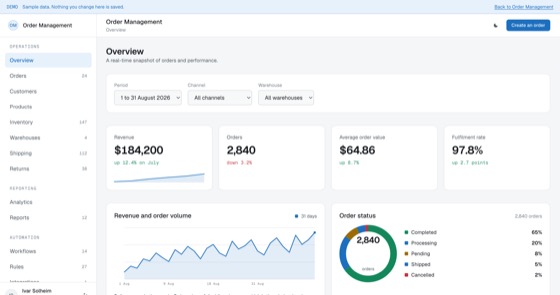
A full order management system: orders, customers, catalogue, stock, warehouses, shipping, returns, automation rules and integrations.
5.0 out of 510 sold
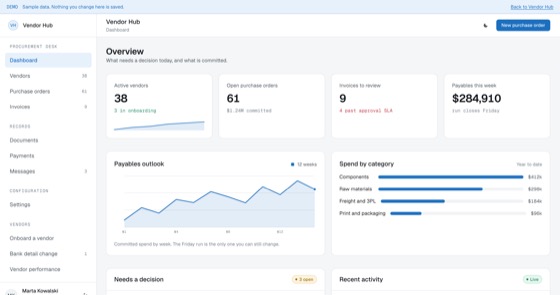
Two sides on one schema: your procurement desk, and a login where vendors acknowledge orders, invoice and keep documents current.
4.0 out of 54 sold
Questions
Not covered here?
Ask a consultant directly. No form to fill in first, and no follow-up sequence.
Book a consultantAll questionsYes. The repository, application code, database schema, migrations, seed data and deployment configuration, is transferred to your organisation on delivery. This matters more here than anywhere else in the catalogue: an ERP you cannot read is an ERP you cannot leave.
It covers the operational spine, order to cash, purchase to pay, perpetual inventory, production scheduling, projects, invoicing and approvals, on one schema, which is what most product businesses actually need. It is not a tier-one ERP with manufacturing resource planning, multi-entity consolidation or payroll built in. If you need those, say so early and we will tell you honestly whether a fitted build gets you there.
Usually it sits alongside it. The suite owns operational transactions and produces the trial balance extract your accountant asks for; most clients keep their statutory accounting package and integrate. Replacing it outright is possible but is a bigger conversation than a fitted build.
As many as you like. Per-seat ERP licensing is why warehouse staff end up sharing a login, which destroys your audit trail. Pricing here is per application, so everyone gets their own account and every action is attributable.
That is the usual route, and this build is customised more often than any other. A fitted build adjusts document numbering, the chart of accounts mapping, costing method, approval thresholds, tax handling, branding and up to two integrations. Budget toward the upper end of the one to three week range.
Hosting only, paid to your own cloud provider, typically $100 to $300 a month for an ERP workload, which carries more history and more concurrent users than the other apps.
Start here
A fitted build adjusts fields, stages, roles and integrations to how your team already works. One scoping call, a fixed price, one to three weeks.