Pipeline CRM
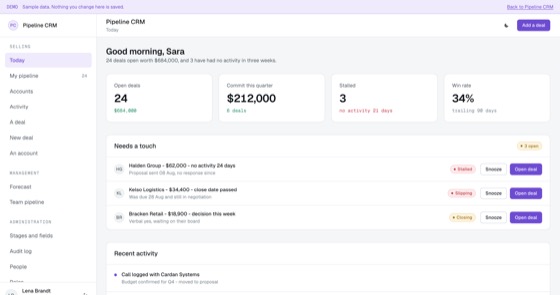
Deal stages, forecasting and activity history for a sales team that has outgrown a spreadsheet.
5.0 out of 511 sold
PortfolioCSM1 / 8
4.5 out of 56 sold
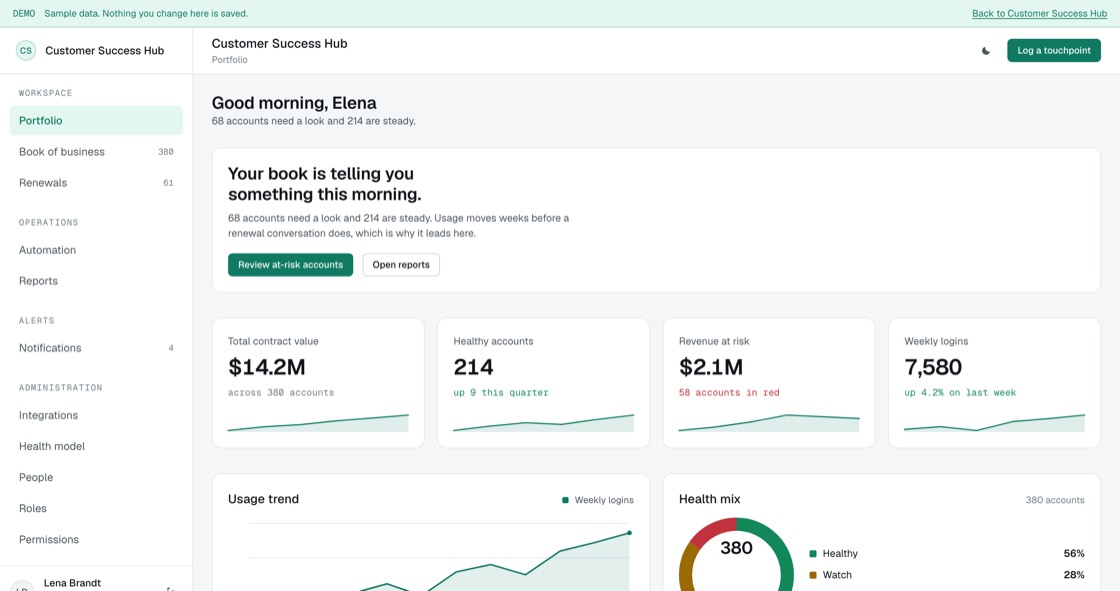
Everything a CSM needs to answer one question before the renewal call: is this account getting value, and can I prove it?
From$649
Inside the app
23 connected functions on one schema, spanning three permission levels. Everything below is in the template before a line of customisation.
Opens on contract value, healthy accounts and revenue at risk, with a twelve-week usage trend beside them. Usage moves weeks before a renewal conversation does.
Every account filtered by health, stage and segment, sorted worst-health first by default because that is the order the work actually arrives in.
Upcoming, negotiating and committed, each with a probability and a countdown. The weighted number is the one you defend in a forecast meeting.
Rules written as trigger, condition and actions, with a log of what each one did. A rule that fires with no record is a rule nobody trusts.
Health mix, churn trend, renewal forecast, adoption by segment, task completion, lifecycle funnel and workload by CSM. All the monthly questions in one place.
What the rules raised and what was emailed on your behalf, in one centre. Turning a rule off stops the noise at source rather than hiding it.
Which sources are connected, and plainly what the health model loses without each one. It keeps working on fewer signals rather than breaking.
The weights behind every score, with a live preview of how many accounts would change band before you apply it. Nobody is told until you do.
Permissions
A CSM sees their own book. A team lead sees the whole team and the risk pipeline. An administrator owns the scoring model. Every level is included, and the boundaries are enforced on the server rather than by hiding buttons.
The build
11 screens, all of them live in the preview. Nothing on this list is a mockup or a roadmap item.
Access
Workspace
Programme
Management
Administration
What you get
Post-sale teams managing 50–2,000 accounts who track renewals in a spreadsheet and hope.
Access and evidence
When a renewal is lost, the first question is always what changed and who knew. Both are answered by the data model rather than by a report someone assembles after the fact.
Related
Deal stages, forecasting and activity history for a sales team that has outgrown a spreadsheet.
5.0 out of 511 sold
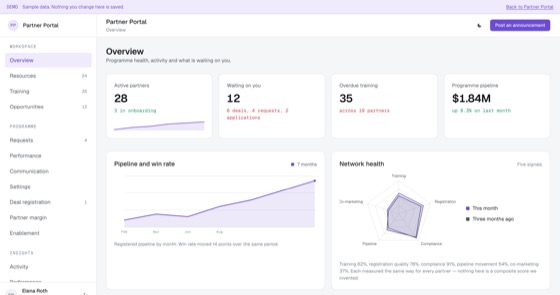
A whole partner programme in one app: deal registration, a gated resource library, training, funding requests and tier performance.
4.0 out of 53 sold
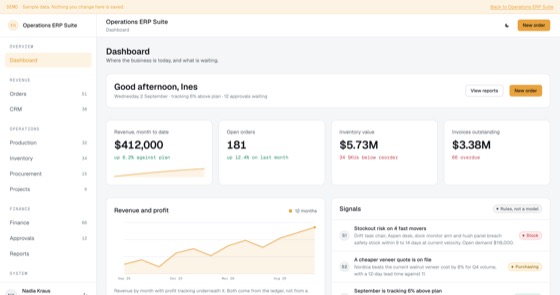
The full ERP spine: orders, CRM, production, stock, purchasing, projects, finance, approvals, reporting, people and automation.
5.0 out of 58 sold
Questions
Not covered here?
Ask a consultant directly. No form to fill in first, and no follow-up sequence.
Book a consultantAll questionsYes. The repository, application code, database schema, migrations, seed data and deployment configuration, is transferred to your organisation on delivery. There is no licence key and nothing that calls home.
As many as you like, across all three roles. Pricing is per application, not per user, so putting the whole customer success org on it costs the same as putting one pod on it.
Yes, and without a developer. The weights, the data sources behind each factor and the band thresholds are all editable by an administrator, versioned, and applied on the next nightly run. The contributing factors stay visible to every CSM so nobody argues with a black box.
No, and it should not try to. It is the post-sale workspace that sits alongside the CRM. A fitted build syncs accounts, contacts and contract values both ways, so the CRM stays the system of record for the commercial relationship.
That is the usual route. A fitted build adjusts segments, health factors, playbook steps, renewal notice rules, branding and up to two integrations, and typically takes one to three weeks from a signed scope.
Hosting only, paid to your own cloud provider, roughly $50 to $200 a month depending on account volume and telemetry. There is no recurring fee to us unless you choose managed hosting.
Start here
A fitted build adjusts fields, stages, roles and integrations to how your team already works. One scoping call, a fixed price, one to three weeks.