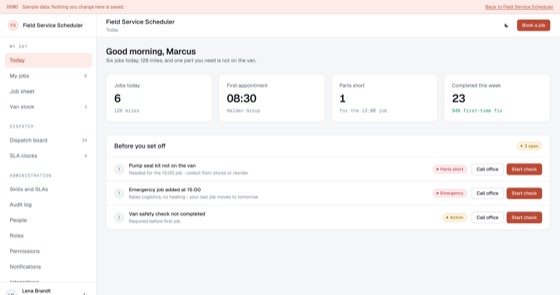
Field Service Scheduler
Dispatch board, engineer routing, job sheets and parts usage for teams that work on site.
5.0 out of 56 sold
TodayDriver1 / 6
4.5 out of 57 sold
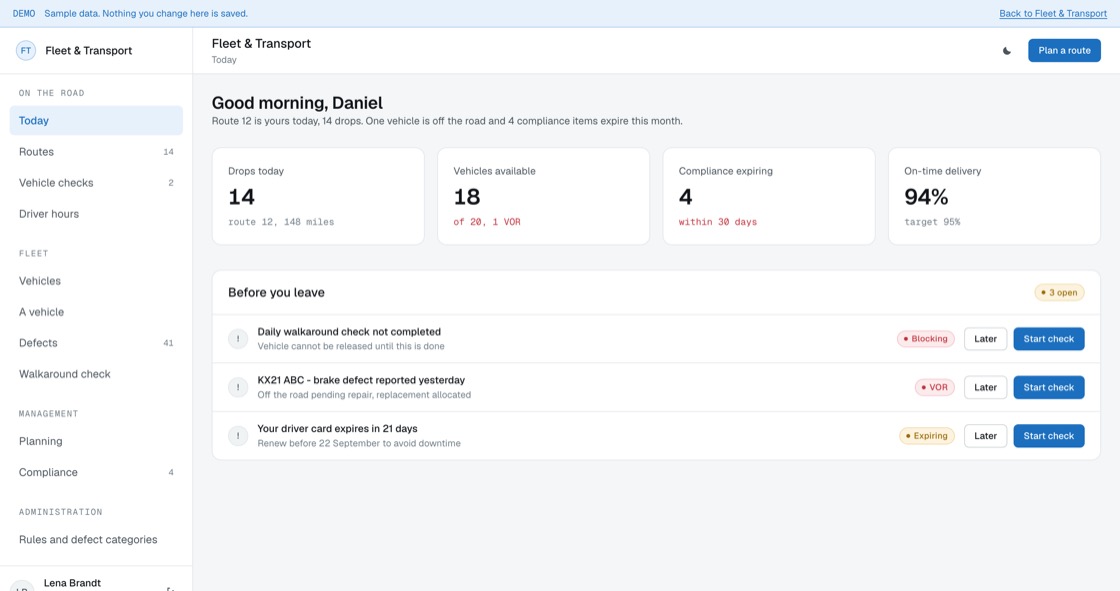
Running vehicles is mostly paperwork you only notice when it is missing. This build keeps the daily checks, licences and hours where an enforcement officer can see them, and blocks a vehicle before it leaves rather than after.
From$729
Inside the app
23 connected functions on one schema, spanning three permission levels. Everything below is in the template before a line of customisation.
Route 12 is yours today, 14 drops. One vehicle is off the road and 4 compliance items expire this month.
Today's drops in sequence, with the window each one must land in.
Daily walkaround, recorded on the phone, before the vehicle moves.
Driving, other work and rest, against the limits that apply to you.
Every vehicle with its documents, service position and current status.
Tomorrow's routes against available vehicles and legal driver hours.
Licences, cards, inspections and tachograph downloads, with expiry ahead of time.
What blocks a vehicle, and how long a document can be overdue before it does.
Every defect, release and override. Retained for the statutory period.
Permissions
A driver sees their route, their check and their hours. A transport manager plans and owns compliance. An administrator sets what blocks a vehicle. The separation matters most under pressure to make a delivery.
The build
10 screens, all of them live in the preview. Nothing on this list is a mockup or a roadmap item.
Access
On the road
Fleet
Management
Administration
What you get
Hauliers, distributors and service fleets running 5 to 500 vehicles.
Access and evidence
The one control that keeps an unroadworthy vehicle parked is that the person under pressure to complete the delivery is not the person who can authorise it to move.
Related
Dispatch board, engineer routing, job sheets and parts usage for teams that work on site.
5.0 out of 56 sold
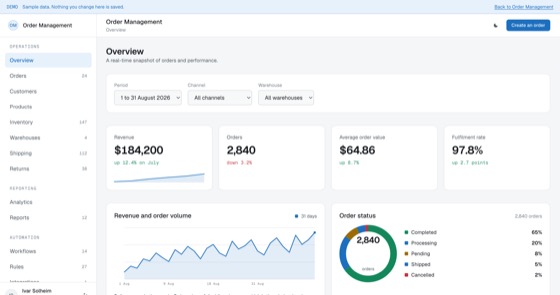
A full order management system: orders, customers, catalogue, stock, warehouses, shipping, returns, automation rules and integrations.
5.0 out of 510 sold
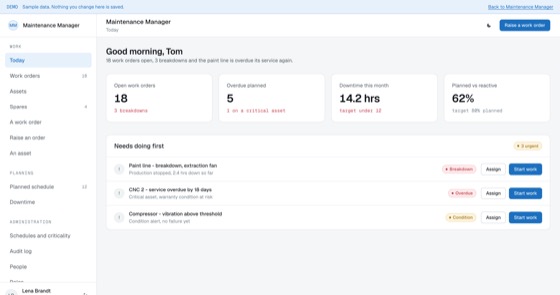
Planned maintenance, breakdown work orders, spares and downtime against every asset.
4.5 out of 57 sold
Questions
Not covered here?
Ask a consultant directly. No form to fill in first, and no follow-up sequence.
Book a consultantAll questionsYes. The repository, application code, database schema, migrations, seed data and deployment configuration, is transferred to your organisation on delivery. There is no licence key and nothing that calls home.
No product can promise that, and you should distrust one that does. What it gives you is the mechanisms compliance depends on: daily checks recorded at the vehicle, defects that actually stop a vehicle, expiry that removes it from planning, and a record you can produce during an enforcement visit. Whether you are compliant depends on your operator licence undertakings and how you run the fleet.
Driver hours can be entered manually in the template, which is enough for a light fleet. Automatic tachograph download and analysis is a standard integration in a fitted build, and is what most operators over about twenty vehicles will want.
It sequences a route and flags stops at risk of missing their window. True multi-vehicle optimisation across a large drop list is a specialist problem, a fitted build can integrate an optimisation provider rather than us pretending to have solved it.
That is the usual route. A fitted build sets up your vehicle types, check templates, defect categories, compliance items, telematics or tachograph integration, branding and up to two integrations, typically in one to three weeks.
Hosting only, paid to your own cloud provider, roughly $50 to $200 a month, rising mainly with photo storage from daily checks.
Start here
A fitted build adjusts fields, stages, roles and integrations to how your team already works. One scoping call, a fixed price, one to three weeks.