Operations ERP Suite
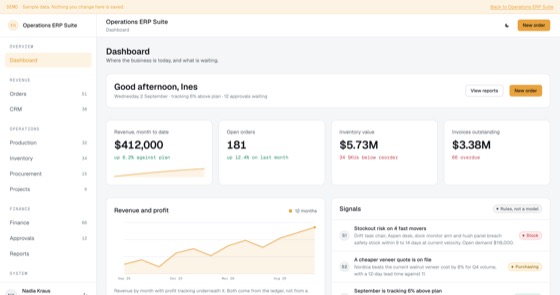
The full ERP spine: orders, CRM, production, stock, purchasing, projects, finance, approvals, reporting, people and automation.
5.0 out of 58 sold
OverviewOwner1 / 8
5.0 out of 510 sold
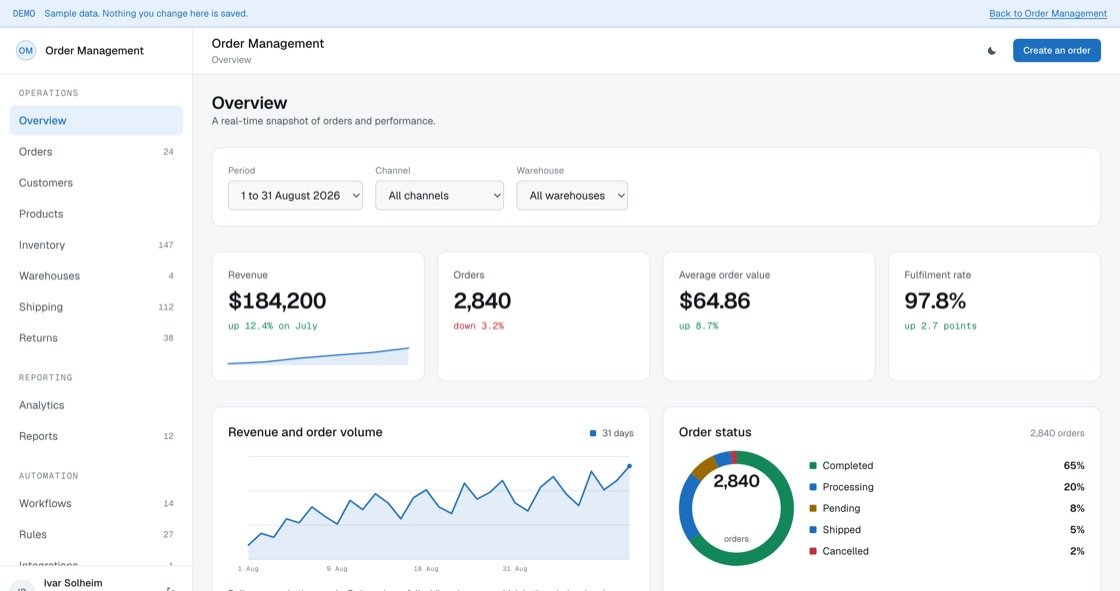
Orders arrive from a storefront, a marketplace, a rep and an inbox. This is where they become one process with one status your support team can read out loud, along with the stock, the warehouses, the carriers, the returns and the rules that decide what happens next.
From$699
Inside the app
27 connected functions on one schema, spanning five permission levels. Everything below is in the template before a line of customisation.
Revenue, orders, average order value and fulfilment rate, with daily revenue, order status, channel mix and region, plus what needs attention today.
Every channel in one list with one status. Held for review is a status, not a note somebody left in a spreadsheet.
One record per buyer across every channel, with lifetime value, payment terms and order history. The same buyer is one row, not two.
Catalogue with price, on hand and reserved. Available to promise is on hand minus reserved, which is the number a customer should be told.
Stock by warehouse with reorder points and quantities already on order, so nothing gets ordered twice.
Capacity used, SKUs stored, staff on site and dispatch time per location. A depot at 91% is a routing decision, not a status light.
Carriers, services, labels and live status. An exception shows on the order too, rather than sitting in a carrier portal.
RMAs with the reason chosen from a list, so "why do things come back" is a report. Wrong item is a warehouse problem; damaged in transit is a carrier one.
Revenue by channel and product with return rate alongside, plus report templates that schedule, export and keep what they contained.
Routing, notifications and fulfilment steps, each with a run count and a success rate. A failed run is retried and then surfaced, never silent.
Pricing, tax, fraud and inventory rules that run in a stated, editable order, so two matching rules cannot produce a different answer on a different day.
Storefront, marketplace, payments and accounting, with failed syncs queued rather than dropped, and five roles narrowed by warehouse scope.
Permissions
A viewer reads. A member works their warehouses. A manager runs the operation. An admin owns the rules and the integrations. The owner sees what it costs. Scope is enforced on the server, and warehouse scope narrows a member further still.
The build
17 screens, all of them live in the preview. Nothing on this list is a mockup or a roadmap item.
Access
Operations
Reporting
Automation and admin
What you get
Ecommerce and wholesale operations shipping from tens to thousands of orders a day.
Access and evidence
Silently backordering a customer who was given a date is the fastest way to lose them. When stock will not make the promise, the app forces a decision rather than letting the date slip quietly.
Related
The full ERP spine: orders, CRM, production, stock, purchasing, projects, finance, approvals, reporting, people and automation.
5.0 out of 58 sold
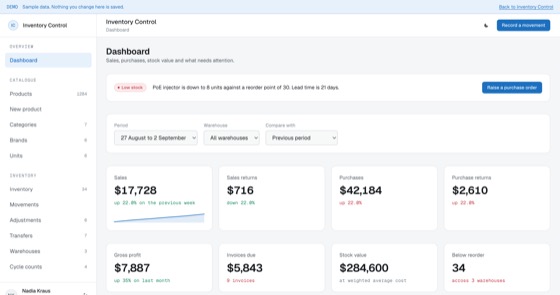
Catalogue, stock, warehouses, purchase orders, suppliers, sales, cycle counts and valuation, on one append-only movement ledger.
5.0 out of 510 sold
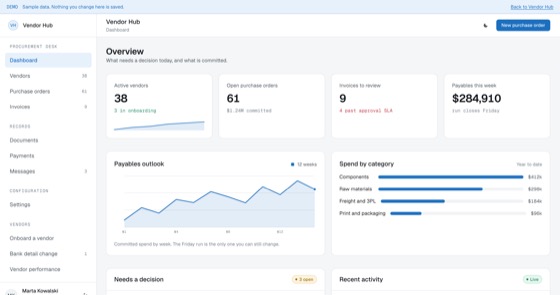
Two sides on one schema: your procurement desk, and a login where vendors acknowledge orders, invoice and keep documents current.
4.0 out of 54 sold
Questions
Not covered here?
Ask a consultant directly. No form to fill in first, and no follow-up sequence.
Book a consultantAll questionsYes. The repository, application code, database schema, migrations, seed data and deployment configuration, is transferred to your organisation on delivery. There is no licence key and nothing that calls home.
The schema and queue are built for tens of thousands of orders a day; the practical limit is your hosting rather than your licence. Pricing does not change with volume, so a peak trading week costs you nothing extra.
Web, marketplace and manual entry are normalised into one queue out of the box, keeping each order's source reference for reconciliation. Connecting your specific storefront or marketplace accounts is a standard integration in a fitted build.
It raises an exception rather than silently backordering. The order is held, a substitute is suggested if one meets the rules, and if the promise cannot be met it is re-quoted and recorded. The customer-facing status never shows a date that is already impossible.
That is the usual route. A fitted build adjusts channels, allocation priority, substitution rules, pick strategy, carrier integrations, branding and up to two integrations, and typically takes one to three weeks from a signed scope.
Hosting only, paid to your own cloud provider, roughly $50 to $200 a month depending on order volume and how much history you retain.
Start here
A fitted build adjusts fields, stages, roles and integrations to how your team already works. One scoping call, a fixed price, one to three weeks.