Field Service Scheduler
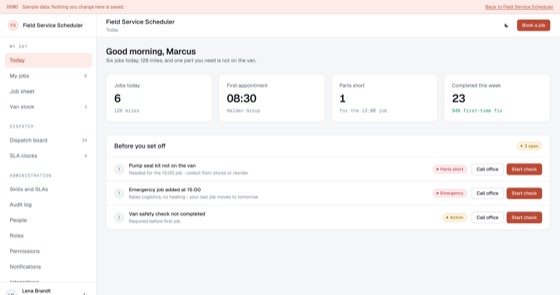
Dispatch board, engineer routing, job sheets and parts usage for teams that work on site.
5.0 out of 56 sold
TodayTeam Member1 / 6
5.0 out of 59 sold
Built around the question agencies and consultancies actually ask: is this project going to make money, and will we know before it is finished?
From$529
Inside the app
22 connected functions on one schema, spanning three permission levels. Everything below is in the template before a line of customisation.
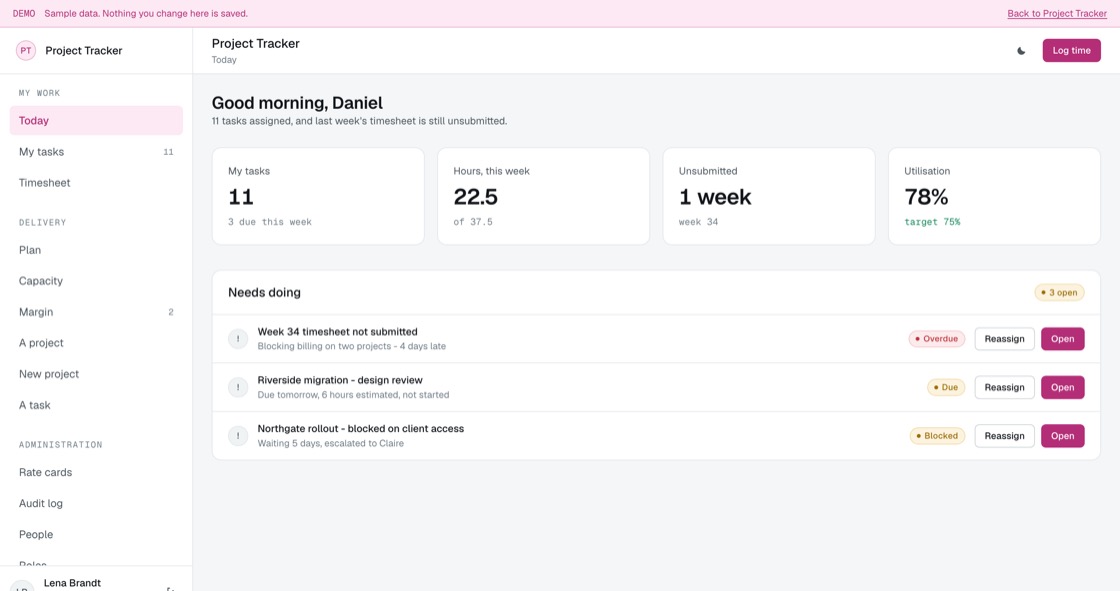
11 tasks assigned, and last week's timesheet is still unsubmitted.
What is assigned to you, on which project, and what it is worth.
Weekly entry, approved by the project manager, locked once billed.
Tasks and milestones against a saved baseline, so slip is measured.
Assigned hours against available hours, before the plan is committed.
Billable value against the cost of delivered hours, per project.
What each grade costs and what it bills at, per client where it differs.
Every approval, rate change and adjustment. Retained for seven years.
Permissions
A team member logs time. A project manager owns the plan, capacity and margin. An administrator sets rates. Margin becomes visible at 40% complete, which is the only point it can still be fixed.
The build
9 screens, all of them live in the preview. Nothing on this list is a mockup or a roadmap item.
Access
My work
Delivery
Administration
What you get
Agencies, consultancies and internal delivery teams that bill or cost by the hour.
Access and evidence
Project margin discovered at close is a post-mortem. Cost of delivered hours against billable value, updated as time is approved, is a decision you can still act on.
Related
Dispatch board, engineer routing, job sheets and parts usage for teams that work on site.
5.0 out of 56 sold
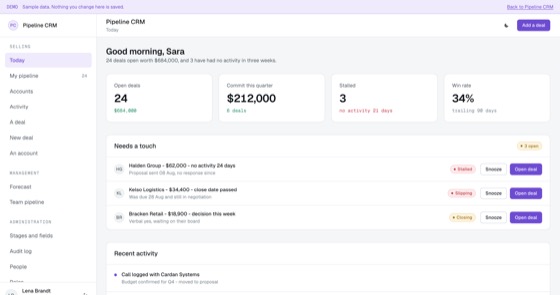
Deal stages, forecasting and activity history for a sales team that has outgrown a spreadsheet.
5.0 out of 511 sold
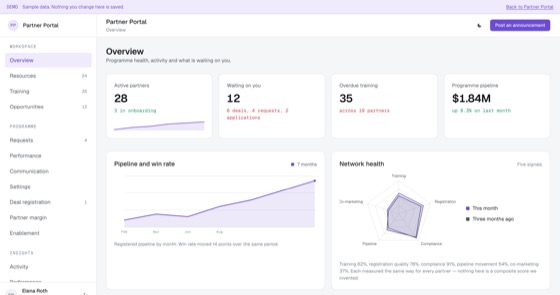
A whole partner programme in one app: deal registration, a gated resource library, training, funding requests and tier performance.
4.0 out of 53 sold
Questions
Not covered here?
Ask a consultant directly. No form to fill in first, and no follow-up sequence.
Book a consultantAll questionsYes. The repository, application code, database schema, migrations, seed data and deployment configuration, is transferred to your organisation on delivery.
As many as you like. Per-seat pricing on a timesheet system is self-defeating: the value depends on everyone recording time, and charging per head is exactly the wrong incentive.
Because an editable timesheet is an invoice you cannot defend. Once time has been billed it is part of a commercial record, so corrections become adjustments with a reason attached rather than silent edits.
That is the point of it. Billable value against the cost of delivered hours updates as time is approved, so margin is visible at 40% complete rather than discovered at close.
That is the usual route. A fitted build sets up your project and phase structure, grades and rate cards, approval rules, utilisation targets, branding and up to two integrations.
Hosting only, paid to your own cloud provider, roughly $50 to $200 a month.
Start here
A fitted build adjusts fields, stages, roles and integrations to how your team already works. One scoping call, a fixed price, one to three weeks.