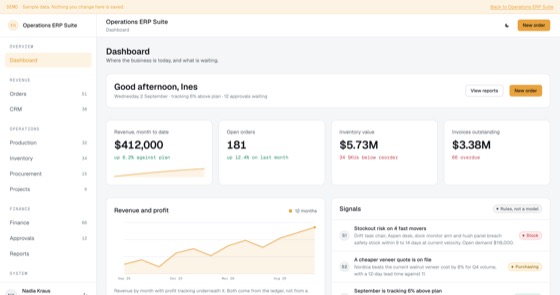
Operations ERP Suite
The full ERP spine: orders, CRM, production, stock, purchasing, projects, finance, approvals, reporting, people and automation.
5.0 out of 58 sold
TodayOperator1 / 6
4.5 out of 56 sold
The gap our ERP suite openly admits. Works orders against a bill of material, real routings with capacity, and booking that happens on the shop floor rather than being reconstructed from memory on Friday.
From$849
Inside the app
23 connected functions on one schema, spanning three permission levels. Everything below is in the template before a line of customisation.
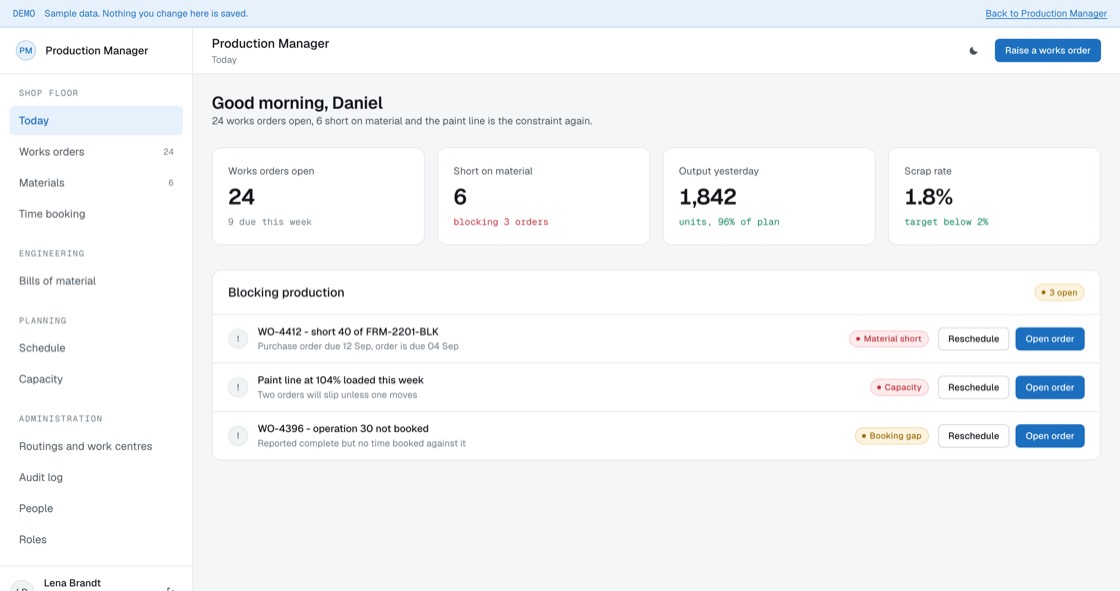
24 works orders open, 6 short on material and the paint line is the constraint again.
What is being made, from which bill of material, and where it has got to.
What each order needs, what is free, and what is on order.
Booked on the floor, against the operation, at the time it happened.
What goes into what, at which revision, with where-used both ways.
What runs where and when, with the orders that will slip shown as slipping.
Available hours against loaded hours, by work centre. The constraint is always visible.
The operations a product goes through, and the standard time for each.
Every release, booking correction and routing change. Retained for seven years.
Permissions
An operator works orders and books time. A planner owns the schedule and the constraint. An administrator owns routings and standards. Booked time feeds both job costing and the capacity picture, so it is entered once.
The build
10 screens, all of them live in the preview. Nothing on this list is a mockup or a roadmap item.
Access
Shop floor
Engineering
Planning
Administration
What you get
Light manufacturers and assemblers running make-to-order or make-to-stock, 5 to 200 operators.
Access and evidence
Standard times drift out of date within months, and a schedule built on stale standards lies confidently. Booked actuals feed back automatically, so when the plan stops being true you find out from the app rather than from a late order.
Related
The full ERP spine: orders, CRM, production, stock, purchasing, projects, finance, approvals, reporting, people and automation.
5.0 out of 58 sold
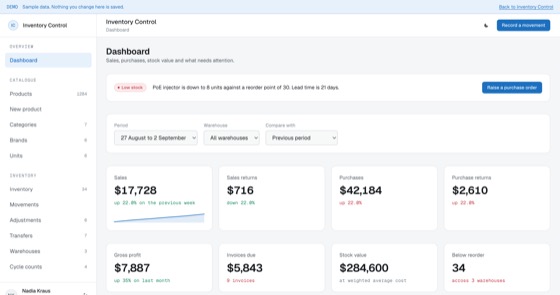
Catalogue, stock, warehouses, purchase orders, suppliers, sales, cycle counts and valuation, on one append-only movement ledger.
5.0 out of 510 sold
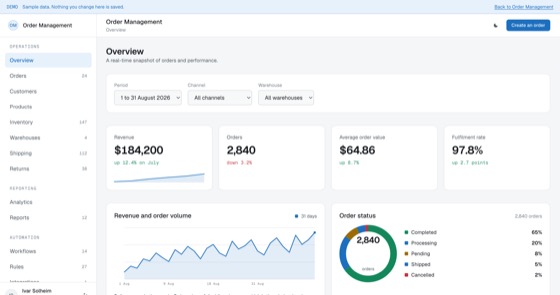
A full order management system: orders, customers, catalogue, stock, warehouses, shipping, returns, automation rules and integrations.
5.0 out of 510 sold
Questions
Not covered here?
Ask a consultant directly. No form to fill in first, and no follow-up sequence.
Book a consultantAll questionsYes. The repository, application code, database schema, migrations, seed data and deployment configuration, is transferred to your organisation on delivery. There is no licence key and nothing that calls home.
It covers works orders, bills of material, routings, material availability, shop-floor booking, finite scheduling and capacity loading, the parts most light manufacturers actually use. It is not a full MRP II system with demand forecasting, multi-level netting and master production scheduling. If you need those, say so early and we will tell you honestly whether a fitted build gets you there.
That is the intended pairing, and it is the gap the ERP page openly admits. In a fitted build they share one schema, so stock consumed by a works order and the finished goods it produces post straight into the ledger rather than being reconciled afterwards.
On a terminal or tablet at the work centre, against the operation, at the time it happens. That single entry drives job costing, the capacity picture and the correction applied to standard times, which is why it is worth insisting on rather than collecting on paper.
That is the usual route. A fitted build sets up your work centres, routings, BOM structure, booking terminals, scrap and yield rules, branding and up to two integrations. Budget toward the upper end of the one to three week range.
Hosting only, paid to your own cloud provider, roughly $50 to $200 a month, rising with how much booking history you retain.
Start here
A fitted build adjusts fields, stages, roles and integrations to how your team already works. One scoping call, a fixed price, one to three weeks.