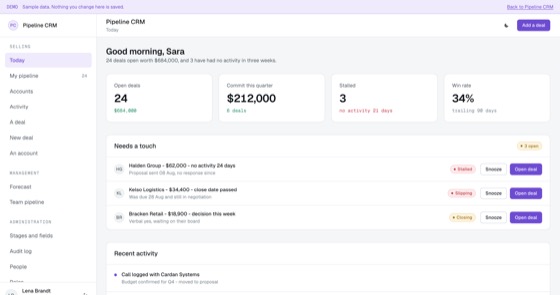
Pipeline CRM
Deal stages, forecasting and activity history for a sales team that has outgrown a spreadsheet.
5.0 out of 511 sold
OverviewReader1 / 6
5.0 out of 58 sold
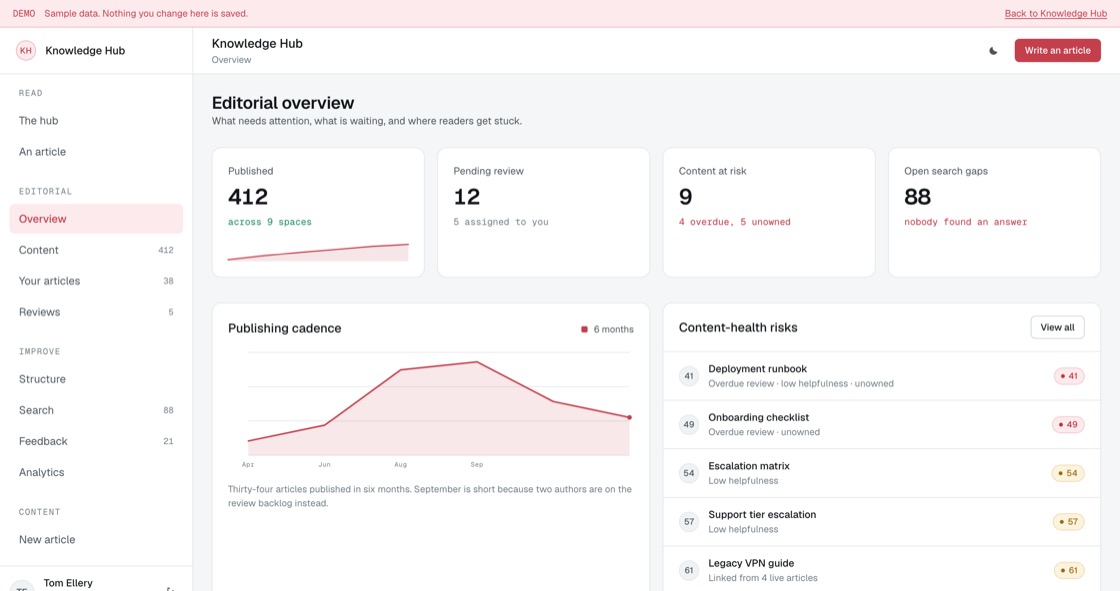
Most internal wikis fail the same way: nobody owns the page and nobody knows it went stale. This build makes ownership and freshness structural.
From$479
Inside the app
25 connected functions on one schema, spanning six permission levels. Everything below is in the template before a line of customisation.
Nine articles are overdue for review and two of them are the most-read pages here.
Spaces and what is in them, with freshness shown up front.
What changed, who changed it, and when it is next due for review.
What you own, and what you owe a review on.
Overdue and upcoming, ordered by how much the article is actually read.
What people looked for and did not find. The list of what to write next.
Who can read and who can edit, per space.
Every edit, permission change and archive. Retained for seven years.
Permissions
A reader searches and reads. An editor owns articles and works the review queue. An administrator sets spaces and permissions. Ownership and freshness are structural rather than aspirational.
The build
9 screens, all of them live in the preview. Nothing on this list is a mockup or a roadmap item.
Access
Knowledge
Editing
Administration
What you get
Operations, support and engineering teams whose knowledge currently lives in chat history.
Access and evidence
Internal wikis fail the same way everywhere: nobody owns the page and nobody knows it went stale. Making ownership and freshness structural is the only thing that reliably prevents it.
Related
Deal stages, forecasting and activity history for a sales team that has outgrown a spreadsheet.
5.0 out of 511 sold
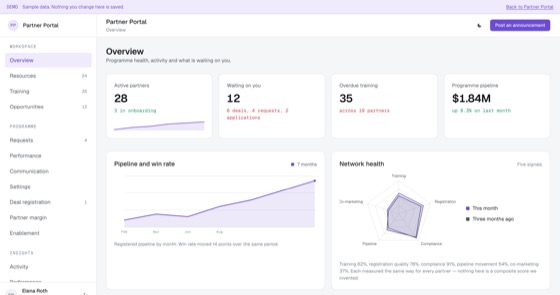
A whole partner programme in one app: deal registration, a gated resource library, training, funding requests and tier performance.
4.0 out of 53 sold
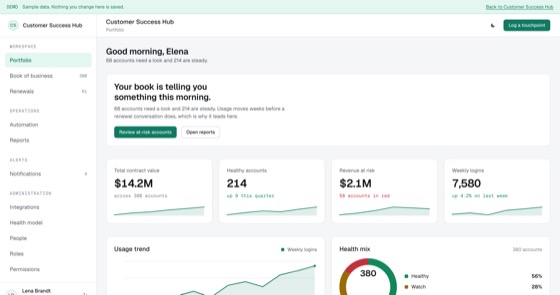
Health scores, renewal calendars and QBR prep for the team that keeps revenue from leaking.
4.5 out of 56 sold
Questions
Not covered here?
Ask a consultant directly. No form to fill in first, and no follow-up sequence.
Book a consultantAll questionsYes. The repository, application code, database schema, migrations, seed data and deployment configuration, is transferred to your organisation on delivery.
As many as you like. Per-seat pricing on a knowledge base is self-defeating, the whole point is that everyone can find the answer without asking a person.
Two things made structural rather than optional. Every article has a named owner, not a team, and every article has its own review interval. Overdue articles are flagged where readers see them, and unowned ones escalate.
Searches that returned nothing. It is the most useful content plan available, because it is a list of what people actually wanted and could not find, far better than guessing what to document next.
That is the usual route. A fitted build sets up your spaces and permissions, review intervals, article templates, search synonyms for your internal vocabulary, branding and up to two integrations.
Hosting only, paid to your own cloud provider, roughly $50 to $200 a month.
Start here
A fitted build adjusts fields, stages, roles and integrations to how your team already works. One scoping call, a fixed price, one to three weeks.