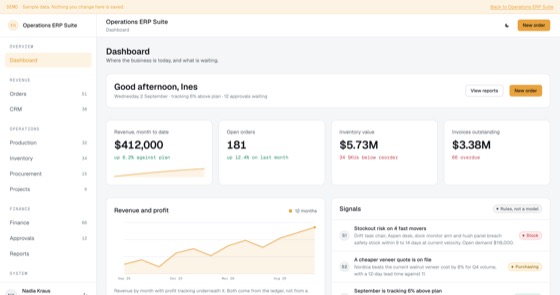
Operations ERP Suite
The full ERP spine: orders, CRM, production, stock, purchasing, projects, finance, approvals, reporting, people and automation.
5.0 out of 58 sold
OverviewBookkeeper1 / 6
5.0 out of 57 sold
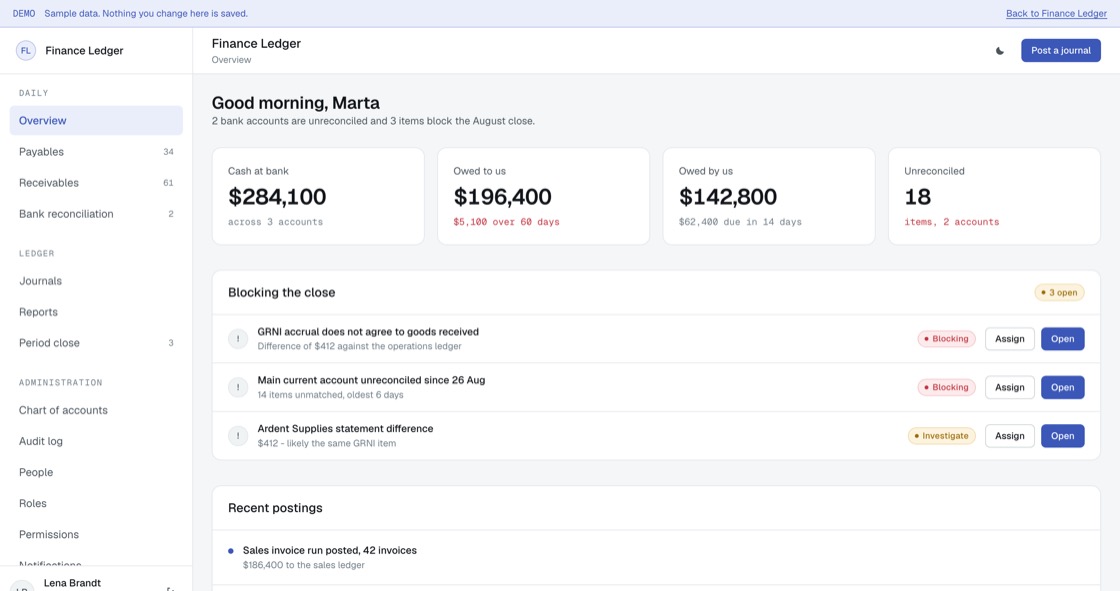
Accounting software is where most internal builds quietly give up and export to a spreadsheet. This one keeps double entry honest: every posting balances, every period locks, and every figure traces back to a document.
From$849
Inside the app
23 connected functions on one schema, spanning three permission levels. Everything below is in the template before a line of customisation.
2 bank accounts are unreconciled and 3 items block the August close.
Supplier invoices, matched and scheduled. Nothing pays without a match.
What customers owe, how old it is, and who is chasing it.
Statement lines matched to postings. Unmatched items are the whole point.
Every posting balances. Unbalanced entries cannot be saved, let alone posted.
Trial balance, profit and loss, balance sheet and VAT, from the same postings.
Lock the period only when nothing is unposted and nothing is unreconciled.
The structure everything posts into. Changing it is deliberately awkward.
Every posting, reopening and account change. Retained for seven years.
Permissions
A bookkeeper enters and reconciles. A controller posts journals and runs the close. An administrator owns the chart of accounts. Segregation of duties is the point of this app, so it is enforced on the server rather than by convention.
The build
10 screens, all of them live in the preview. Nothing on this list is a mockup or a roadmap item.
Access
Daily
Ledger
Administration
What you get
Finance teams who want their ledger in the same system as their operations, not bridged to it.
Access and evidence
Most internal finance builds fail the same way: they let an unbalanced entry through, or let a period close with something unposted. Both are prevented here by the data model, not by a reminder in a spreadsheet.
Related
The full ERP spine: orders, CRM, production, stock, purchasing, projects, finance, approvals, reporting, people and automation.
5.0 out of 58 sold
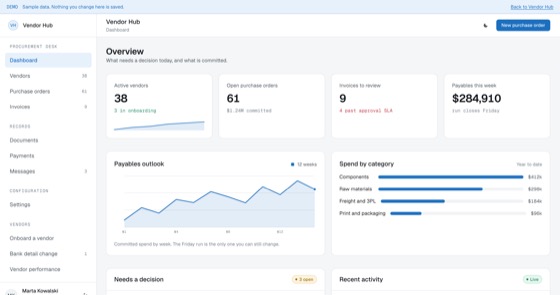
Two sides on one schema: your procurement desk, and a login where vendors acknowledge orders, invoice and keep documents current.
4.0 out of 54 sold
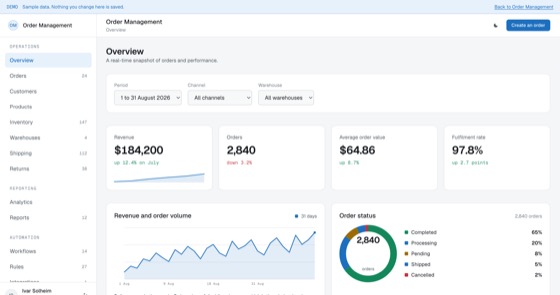
A full order management system: orders, customers, catalogue, stock, warehouses, shipping, returns, automation rules and integrations.
5.0 out of 510 sold
Questions
Not covered here?
Ask a consultant directly. No form to fill in first, and no follow-up sequence.
Book a consultantAll questionsYes. The repository, application code, database schema, migrations, seed data and deployment configuration, is transferred to your organisation on delivery. For a ledger this matters more than usual: your accounting records should not depend on a vendor staying in business.
For many product and service businesses, yes, it covers the general ledger, payables, receivables, bank reconciliation, journals and period close on a proper double-entry schema. What it does not do is file your statutory returns for you or carry the accreditations some jurisdictions require of filing software. Talk to your accountant before deciding, and we will tell you honestly what a fitted build covers.
Tax codes are per account and per customer location, so reverse charge and exempt supplies are handled rather than bolted on. Multi-currency with revaluation is a standard addition in a fitted build.
Three ways. An unbalanced journal cannot be saved. A draft journal has no effect until posted. And a posted entry can never be edited, corrections are new entries, so the trail stays intact. Segregation between who enters and who posts is enforced by role.
That is the usual route. A fitted build sets up your chart of accounts, tax codes, document numbering, approval limits, reporting pack, branding and up to two integrations. Budget toward the upper end of the one to three week range, ledgers reward care.
Hosting only, paid to your own cloud provider, typically $100 to $300 a month, since a ledger accumulates more history than most applications and you will want solid backups.
Start here
A fitted build adjusts fields, stages, roles and integrations to how your team already works. One scoping call, a fixed price, one to three weeks.