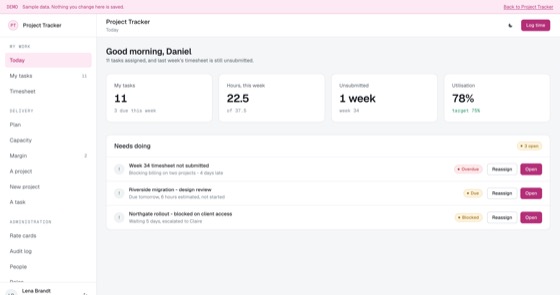
Project Tracker
Plans, capacity, timesheets and margin per project, for teams that bill their time.
5.0 out of 59 sold
DashboardEvent manager1 / 8
An event is a project with a hard deadline and an audience watching. This build covers the unglamorous half, venues and holds, tickets and held-back stock, room capacity, the door, exhibitor risk assessments, supplier insurance, unfilled shifts and what it actually cost, and gives attendees their own login.
From$629
Inside the app
30 connected functions on one schema, spanning four permission levels. Everything below is in the template before a line of customisation.
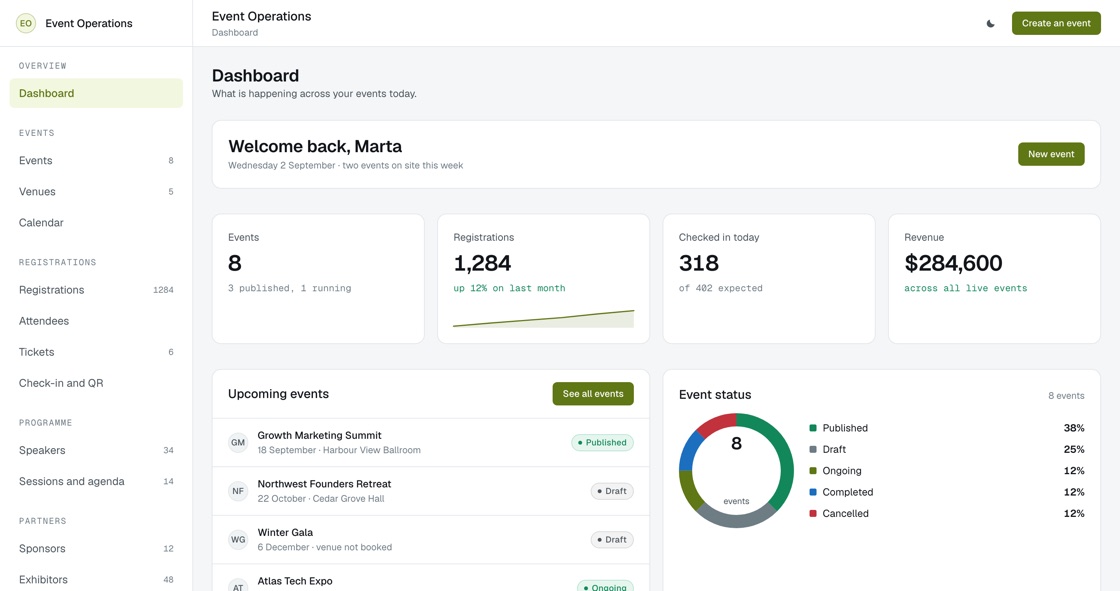
Events, registrations, checked in today and revenue, with what needs a decision and what is happening on site right now.
Draft to completed, with venue capacity against registrations. A venue hold shows its expiry, because holds lost to a missed date are the classic avoidable failure.
Build, rehearsals, doors, programme and derig, not just the event. Most overruns are a derig nobody scheduled against a venue that closes at a fixed time.
Confirmed, pending, waitlisted, cancelled and refunded, with the waitlist ordered by time and promotion recorded as an action.
Types, price, released, sold and held back for sponsors and press, shown separately so the capacity figure stops lying to you two weeks out.
Scan or search, offline-capable, with duplicate scans blocked and unpaid registrations held at the door rather than refused.
Speakers with materials and travel outstanding, and sessions flagged when they exceed the room. Moving one reallocates and notifies every registration.
Packages, invoices and deliverable counts; stands, power, and a rule that no risk assessment means no build slot.
Catering, AV, rigging and security with insurance expiry blocking scheduling, plus shifts, briefings and what is still unfilled.
Ticket payments and sponsor invoices in one list, coupon codes with limits, and membership dues that discount at checkout without a code.
Messages to a live registration query rather than a stale export, feedback with themes assigned by a person, and certificates issued from attendance.
Their next event, their ticket, their sessions, their waitlist place, their registrations and their certificates, on their own account.
Permissions
An attendee gets a real login rather than a confirmation email. Staff get the floor and nothing else, scoped to the events they are working. An event manager runs everything about the event, and a super admin owns the accounts and the rules underneath.
The build
27 screens, all of them live in the preview, including five on the attendee side. Nothing on this list is a mockup or a roadmap item.
Access
Events and registrations
Programme, partners and people
Finance, engagement and insight
What you get
Conference, training and membership teams running 5 to 200 events a year.
Access and evidence
Nobody remembers a well-run registration flow. Everybody remembers being turned away from a session they had booked. Capacity rules are enforced by the app rather than by whoever is watching the inbox.
Related
Plans, capacity, timesheets and margin per project, for teams that bill their time.
5.0 out of 59 sold
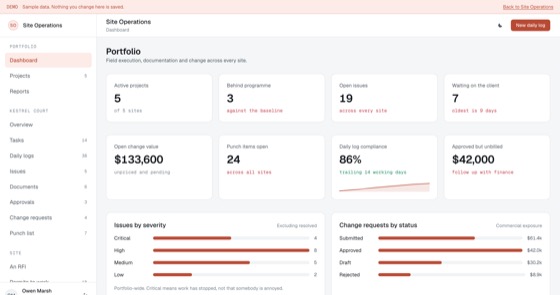
Daily logs, tasks, issues, drawings, approvals, change requests and punch lists across every site, for all six people who look at them.
4.5 out of 53 sold
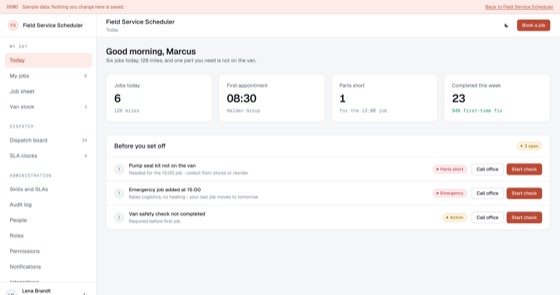
Dispatch board, engineer routing, job sheets and parts usage for teams that work on site.
5.0 out of 56 sold
Questions
Not covered here?
Ask a consultant directly. No form to fill in first, and no follow-up sequence.
Book a consultantAll questionsYes. The repository, application code, database schema, migrations, seed data and deployment configuration, is transferred to your organisation on delivery. There is no licence key and nothing that calls home.
Pricing does not change with either. Teams running 5 events a year and teams running 200 pay the same, and a single event can scale to thousands of attendees, the limit is your hosting rather than your licence.
Yes, and this matters more than any other feature on the day. Venue wifi fails routinely, so the door list is held locally, check-ins are captured offline and reconciled when the connection returns.
The template records what was charged and what is outstanding, and chases unpaid registrations. Taking card payments needs a payment provider, which is a standard integration in a fitted build, we connect your existing merchant account rather than putting ourselves in the money flow.
That is the usual route. A fitted build adjusts ticket types, capacity and waitlist rules, agenda structure, badge design, branding and up to two integrations, and typically takes one to three weeks from a signed scope.
Hosting only, paid to your own cloud provider, roughly $50 to $200 a month depending on attendee volume and how much media you attach to each event.
Start here
A fitted build adjusts fields, stages, roles and integrations to how your team already works. One scoping call, a fixed price, one to three weeks.