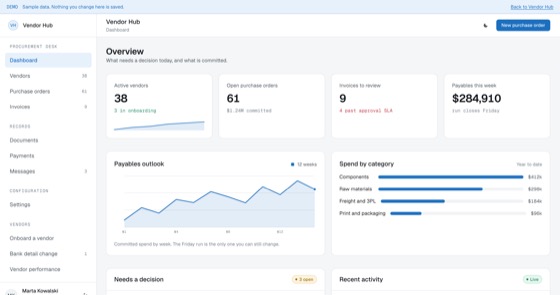
Vendor Hub
Two sides on one schema: your procurement desk, and a login where vendors acknowledge orders, invoice and keep documents current.
4.0 out of 54 sold
OverviewRequester1 / 6
4.5 out of 55 sold
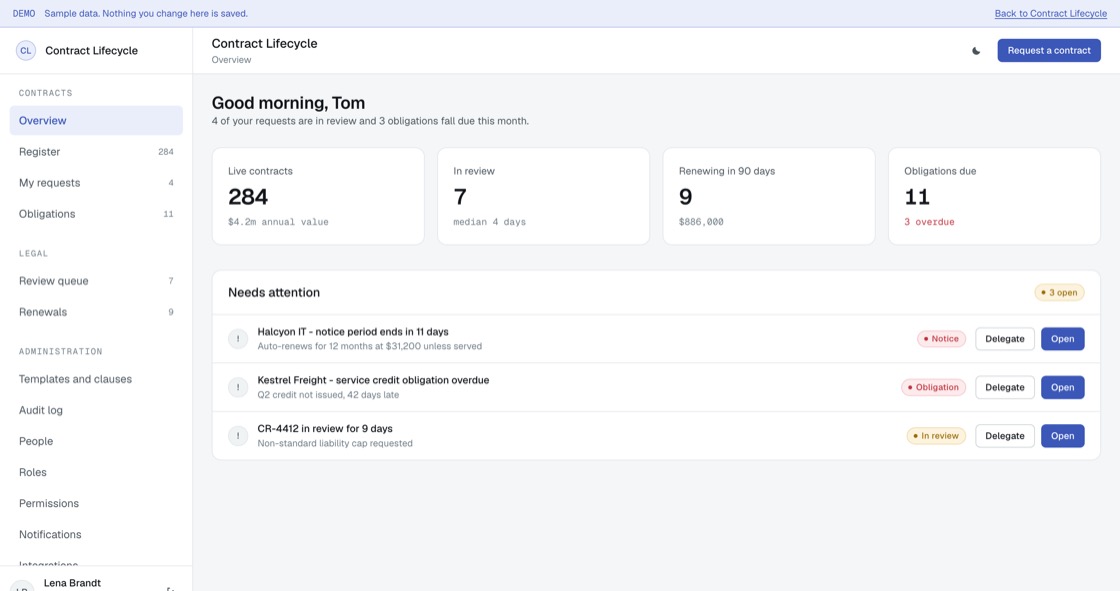
Contracts are signed with enthusiasm and then forgotten in a folder. The obligations inside them do not forget. This build tracks what you promised and tells you before a renewal or a notice period quietly expires.
From$729
Inside the app
23 connected functions on one schema, spanning three permission levels. Everything below is in the template before a line of customisation.
4 of your requests are in review and 3 obligations fall due this month.
Every live agreement, its value, and the dates that matter.
Contracts you have asked for, and where they have got to.
What each contract commits you to, with an owner and a date.
Requests that deviate from the template, with the deviation highlighted.
What renews, when notice must be served, and what it costs to do nothing.
What can be used without review, and what always triggers it.
Every approval, deviation and template change. Retained for the life of the contract plus statute.
Permissions
A requester asks and tracks. A legal reviewer sees only what deviates from the template. An administrator decides what deviation means. Speed comes from approving the ordinary automatically; safety comes from never doing so for certain clauses.
The build
9 screens, all of them live in the preview. Nothing on this list is a mockup or a roadmap item.
Access
Contracts
Legal
Administration
What you get
Companies managing 50 to 5,000 live agreements across customers and suppliers.
Access and evidence
Contracts are signed with enthusiasm and filed. The notice period is the date that costs money when missed, and it is tracked separately from the end date for exactly that reason.
Related
Two sides on one schema: your procurement desk, and a login where vendors acknowledge orders, invoice and keep documents current.
4.0 out of 54 sold
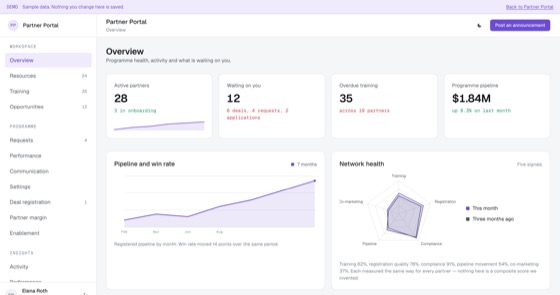
A whole partner programme in one app: deal registration, a gated resource library, training, funding requests and tier performance.
4.0 out of 53 sold
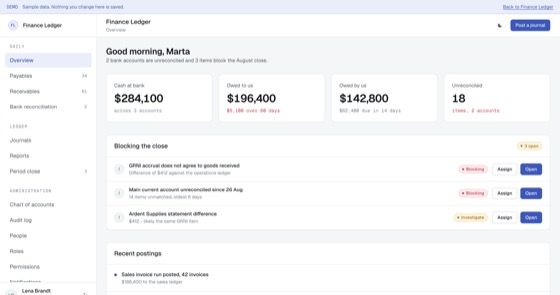
General ledger, payables, receivables and bank reconciliation on one double-entry schema.
5.0 out of 57 sold
Questions
Not covered here?
Ask a consultant directly. No form to fill in first, and no follow-up sequence.
Book a consultantAll questionsYes. The repository, application code, database schema, migrations, seed data and deployment configuration, is transferred to your organisation on delivery. There is no licence key and nothing that calls home.
No, and nothing here should be read as legal advice. It routes work to your lawyers and records what they decided; it does not decide anything legal on its own. The templates and clause library are yours, drafted or approved by your own counsel.
Signature is a specialist, jurisdiction-sensitive service with its own evidentiary requirements. The template tracks a contract through to sent-for-signature and records the outcome; connecting your existing e-signature provider is a standard integration in a fitted build.
By treating the notice date as the important one. It is stored separately from the end date, counted down in days, and surfaced with the annual value attached so the cost of doing nothing is explicit. Auto-renewing contracts are flagged as such.
That is the usual route. A fitted build sets up your templates, clause library, review triggers, approval chain, obligation types, e-signature integration, branding and up to two integrations, and typically takes one to three weeks from a signed scope.
Hosting only, paid to your own cloud provider, roughly $50 to $200 a month, rising mainly with document storage since contracts are retained for a long time.
Start here
A fitted build adjusts fields, stages, roles and integrations to how your team already works. One scoping call, a fixed price, one to three weeks.