Knowledge Hub
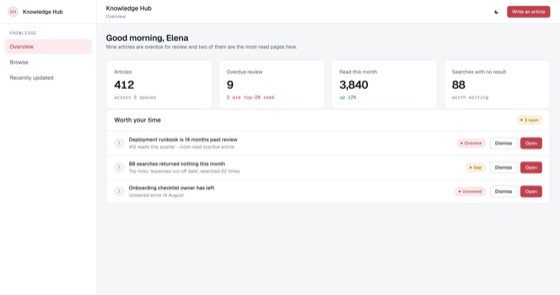
Internal documentation with real search, ownership, review dates and version history.
5.0 out of 58 sold
HomeMember1 / 8
4.0 out of 52 sold
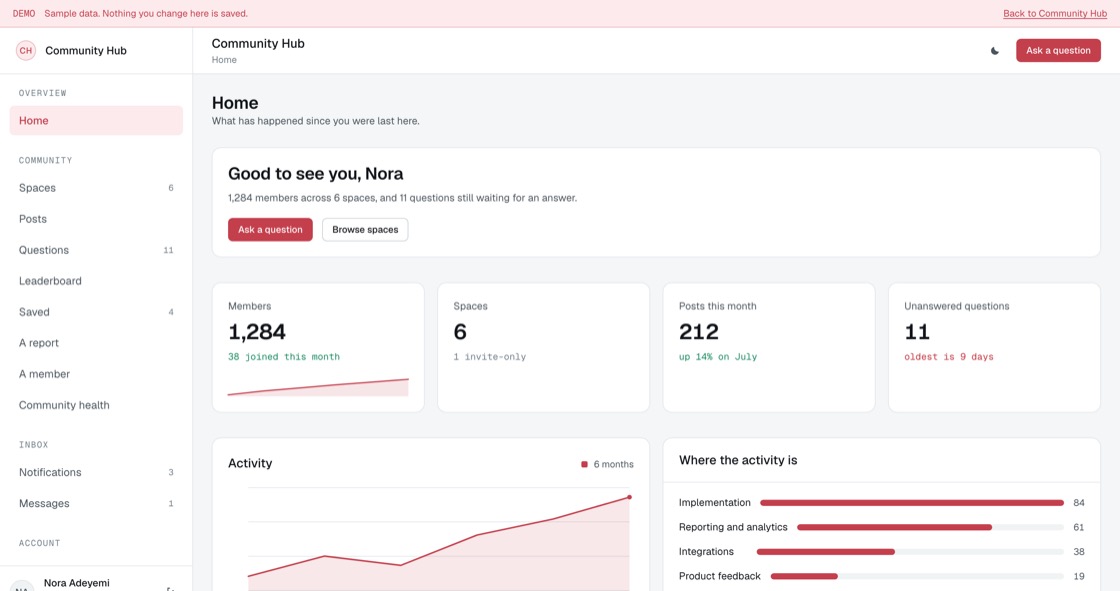
A community is only as good as its worst unmoderated thread, and only as useful as its oldest unanswered question. This build counts both, gives managers a queue that records its reasons, and gives members a board worth coming back to.
From$529
Inside the app
23 connected functions on one schema, spanning three permission levels. Everything below is in the template before a line of customisation.
Members, spaces, posts this month and unanswered questions, with an activity chart and the whole feed rather than a ranked one. Managers also see the queue depth here.
Topic spaces with their own membership, including invite-only ones that are not listed to people outside them. Joining and leaving is one click.
Long and short form across every space, filtered by All, My spaces or Following, and sorted by latest or trending. Latest is the default, because ranking punishes a small community.
Votes, answers, accepted answers and an unanswered filter. The oldest unanswered question is the number a Q&A community lives or dies by.
Ranked by reputation earned from accepted answers and upvotes, not posting volume, with levels and badges. Whether it is public at all is a setting.
Private bookmarks across posts and questions. Nobody is told you saved their post and the count does not rank anything.
Replies, mentions, upvotes and accepted answers, grouped by age, with mark all as read. Each one says what changed rather than that something did.
Direct conversations between named members. There is no anonymous channel, which is a deliberate limit rather than a missing feature.
Reports by reason, space and age. Every action asks for a reason, and the reason is shown to the member.
Append only, including restorations. A manager who reverses another manager is recorded doing it.
Accounts with role, status, reputation and join date. Suspending an account keeps its posts; deleting the member and deleting their contribution are separate decisions.
Held first posts, the report threshold, public leaderboard, private spaces, and exactly what each of the three roles can do.
Permissions
A member posts, asks and answers. A manager works the report queue and the member accounts. An admin owns the rules those two operate under. Every level is included, and the rules are enforced on the server rather than by hiding buttons.
The build
13 screens, all of them live in the preview. Nothing on this list is a mockup or a roadmap item.
Access
Community
Inbox
Moderation and account
What you get
Product, membership and customer communities of 500 to 50,000 people.
Access and evidence
Communities fail on moderation long before they fail on features. Every action here is attributable and reversible, so a removal can be explained to the member it affected rather than quietly disappearing.
Related
Internal documentation with real search, ownership, review dates and version history.
5.0 out of 58 sold
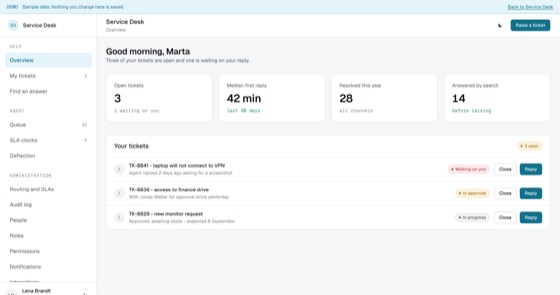
Ticket queues, SLA clocks and a knowledge base that deflects the questions you keep answering.
5.0 out of 59 sold
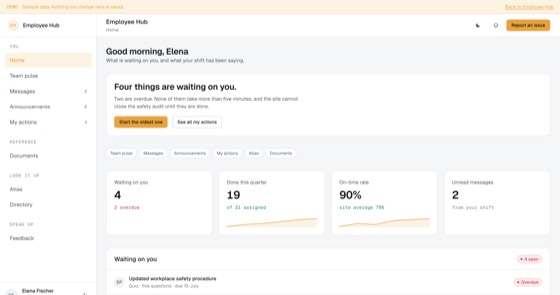
Announcements that require an action, tracked per employee, with reach reporting for managers.
4.5 out of 59 sold
Questions
Not covered here?
Ask a consultant directly. No form to fill in first, and no follow-up sequence.
Book a consultantAll questionsYes. The repository, application code, database schema, migrations, seed data and deployment configuration, is transferred to your organisation on delivery. There is no licence key and nothing that calls home.
Pricing does not change with member count, and the schema is built for six-figure member bases. The practical ceiling is your hosting, not your licence, a community of 50,000 runs comfortably on a modest managed database.
Reports land in one queue with the reason, the space and how long they have waited. A manager removes, moves, dismisses or restores, and every action asks for a reason that is shown to the member. Nothing is removed silently, and the audit log is append only, restorations included.
Yes. Each space is public, members-only or invite-only, and visibility is enforced at the database row level. An invite-only space is genuinely invisible to everyone else rather than merely hidden from the menu.
That is the usual route. A fitted build adjusts spaces, reputation thresholds, automation rules, badges, branding and up to two integrations, and typically takes one to three weeks from a signed scope.
Hosting only, paid to your own cloud provider, roughly $50 to $200 a month depending on member count and attachment storage. There is no recurring fee to us unless you choose managed hosting.
Start here
A fitted build adjusts fields, stages, roles and integrations to how your team already works. One scoping call, a fixed price, one to three weeks.