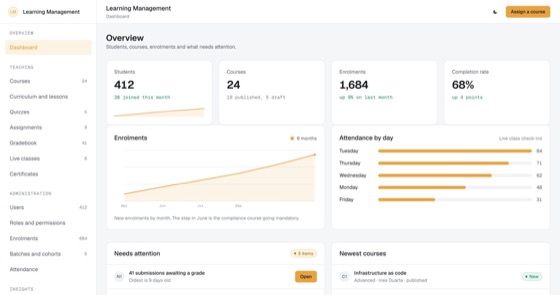
Learning Management
Courses, lessons, quizzes, assignments, a gradebook, live classes, cohorts and certificates, with completion records that survive an audit.
5.0 out of 57 sold
Student overviewStudent1 / 6
4.5 out of 54 sold
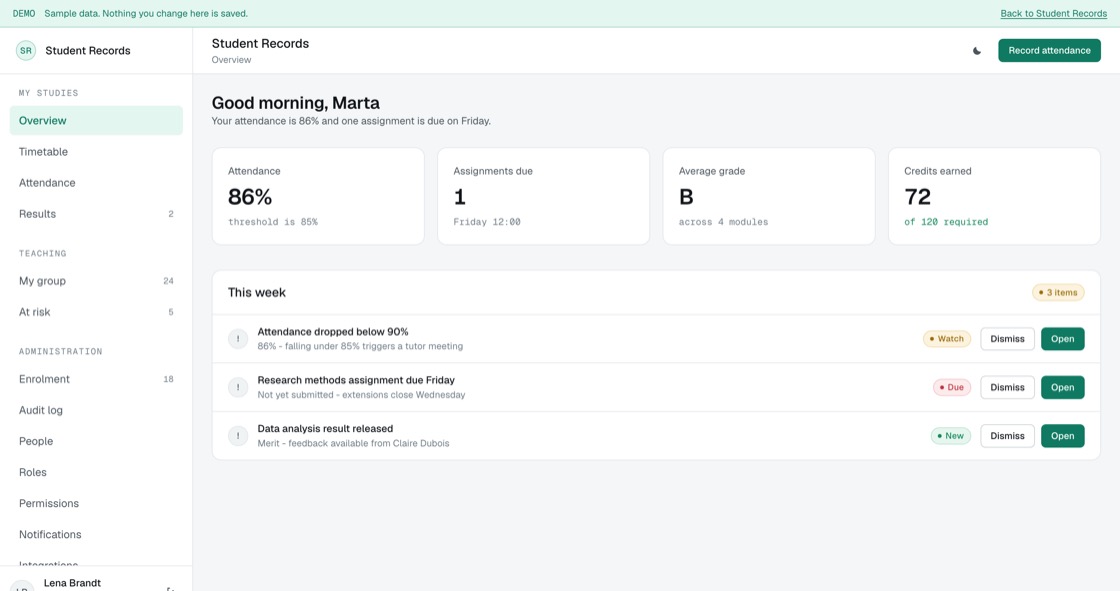
By the time a student formally withdraws, the signals have been visible for months. This build puts attendance, submission and grade trend in one place so somebody notices while there is still time to help.
From$799
Inside the app
22 connected functions on one schema, spanning three permission levels. Everything below is in the template before a line of customisation.
Your attendance is 86% and one assignment is due on Friday.
Where you should be, and who is teaching it.
By module, against the threshold that matters for your course.
Released marks with feedback, and what is still outstanding.
Twenty-four students, with the three numbers that predict withdrawal.
Attendance, submission and grade trend together. One signal is noise; three is a pattern.
Applications, offers and registration, with what is still missing.
Every mark release, enrolment and record access. Retained per your regulator.
Permissions
A student sees their own record. A tutor sees their group and who is drifting. A registrar owns enrolment. Record access is logged whether or not anything was changed, because in education that is the question that gets asked.
The build
9 screens, all of them live in the preview. Nothing on this list is a mockup or a roadmap item.
Access
My studies
Teaching
Administration
What you get
Colleges, training providers and independent schools with 200 to 20,000 learners.
Access and evidence
By the time a student formally withdraws the signals have been visible for months. One weak signal is noise; attendance, submission and grade trend together is a pattern worth acting on.
Related
Courses, lessons, quizzes, assignments, a gradebook, live classes, cohorts and certificates, with completion records that survive an audit.
5.0 out of 57 sold
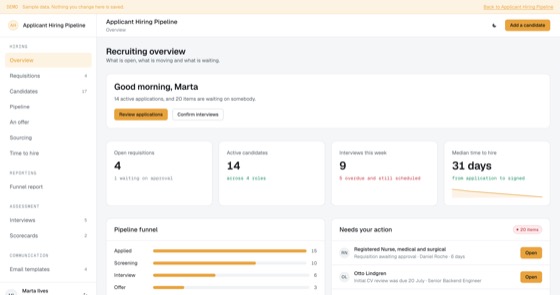
Requisitions, candidates, a stage pipeline, scheduled interviews with scorecards and candidate email templates, an ATS you own outright.
5.0 out of 57 sold
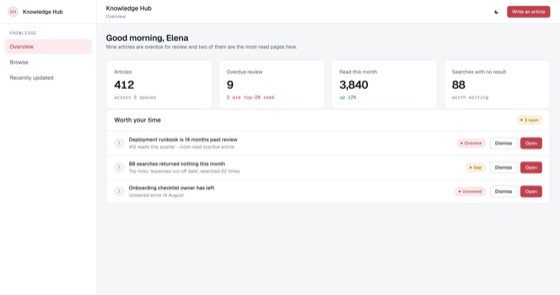
Internal documentation with real search, ownership, review dates and version history.
5.0 out of 58 sold
Questions
Not covered here?
Ask a consultant directly. No form to fill in first, and no follow-up sequence.
Book a consultantAll questionsYes. The repository, application code, database schema, migrations, seed data and deployment configuration, is transferred to your organisation on delivery. There is no licence key and nothing that calls home.
Pricing does not change with learner count, and the schema is built for five-figure cohorts. Every student and tutor can have a login, which is what makes attendance data worth collecting in the first place.
No, and this needs saying plainly: statutory returns are jurisdiction-specific, change regularly and often require accredited software. The template holds the data those returns are built from and exports it. A fitted build can shape the export to your specific return, but you should verify the format with your body first.
It combines attendance, overdue submissions and grade trend rather than triggering on any one. That matters because a single missed week is noise, while all three moving together for a month is the pattern that precedes withdrawal, and the point is to notice while intervention is still possible.
That is the usual route. A fitted build sets up your course structure, assessment types, grading scales, attendance thresholds, enrolment stages, branding and up to two integrations, and typically takes one to three weeks from a signed scope.
Hosting only, paid to your own cloud provider, roughly $50 to $200 a month, rising with cohort size and how many years of records you retain.
Start here
A fitted build adjusts fields, stages, roles and integrations to how your team already works. One scoping call, a fixed price, one to three weeks.