Applicant Hiring Pipeline
Requisitions, candidates, a stage pipeline, scheduled interviews with scorecards and candidate email templates, an ATS you own outright.
5.0 out of 57 sold
TodayConsultant1 / 6
An agency runs two databases that must stay in step: the people and the companies. Most software is good at one. This build treats a placement as the point where both meet, and tracks the margin it actually earned.
From$749
Inside the app
22 connected functions on one schema, spanning three permission levels. Everything below is in the template before a line of customisation.
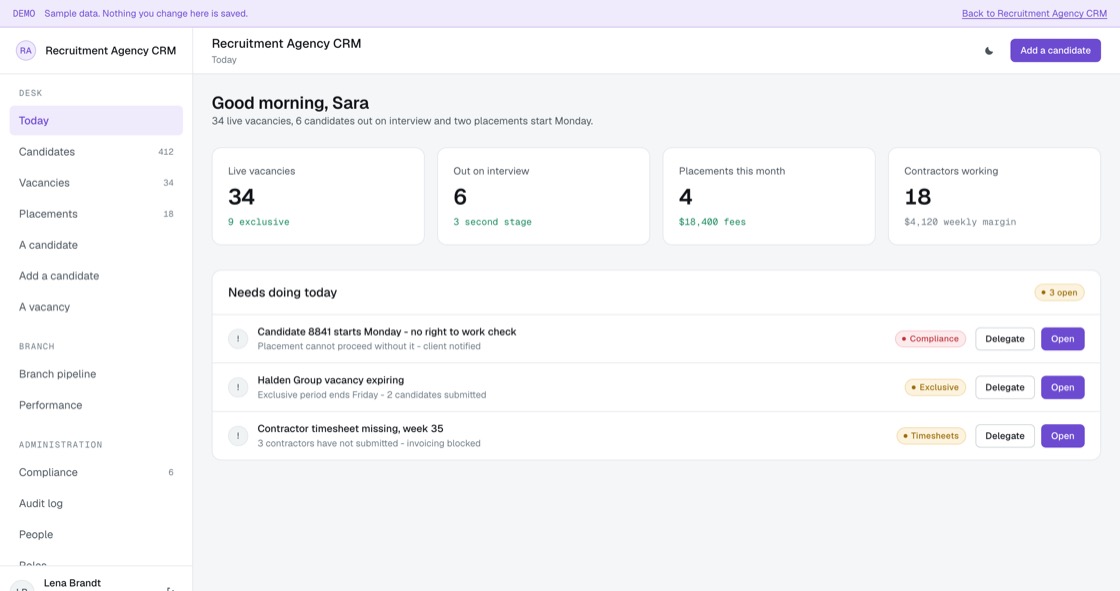
34 live vacancies, 6 candidates out on interview and two placements start Monday.
Your database, with availability and where each one is out.
Client roles you are working, and how competitive each one is.
What was placed, on what terms, and what it actually earned.
Everything the branch is working, weighted by stage.
Where the desk actually makes money, and where it burns time.
Right to work, qualifications and references, before a placement starts.
Every placement, terms change and compliance override. Retained per statute.
Permissions
A consultant works their desk. A branch manager sees margin and which clients are worth the desk time. An administrator owns compliance, deliberately, because the consultant under pressure to hit target should not be able to clear their own blocking document.
02Branch Manager
14 of 22 functions
The build
9 screens, all of them live in the preview. Nothing on this list is a mockup or a roadmap item.
Access
Desk
Branch
Administration
What you get
Recruitment agencies placing permanent and contract staff, 3 to 200 consultants.
Access and evidence
Placing someone without a valid right to work is not a paperwork slip, it is the error that ends businesses. So it is a hard stop rather than a warning, and the person under pressure to hit target cannot clear it.
Related
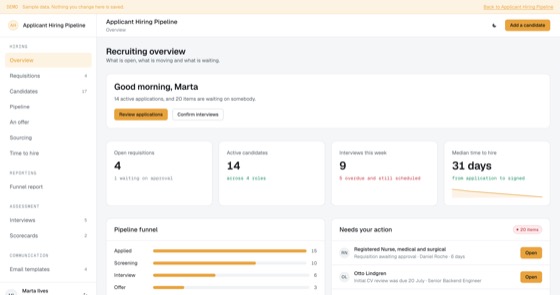
Requisitions, candidates, a stage pipeline, scheduled interviews with scorecards and candidate email templates, an ATS you own outright.
5.0 out of 57 sold
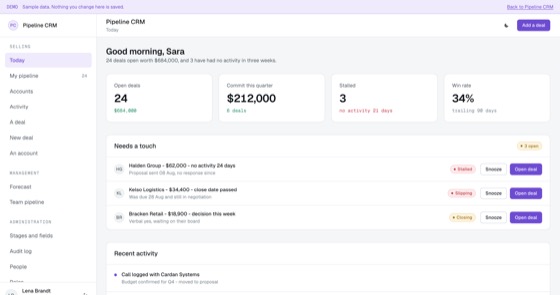
Deal stages, forecasting and activity history for a sales team that has outgrown a spreadsheet.
5.0 out of 511 sold
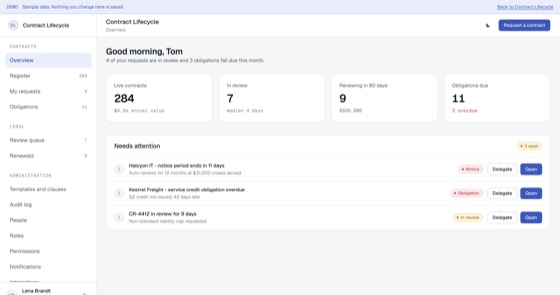
Templates, review queue, obligations and renewal dates that surface before they pass.
4.5 out of 55 sold
Questions
Not covered here?
Ask a consultant directly. No form to fill in first, and no follow-up sequence.
Book a consultantAll questionsYes. The repository, application code, database schema, migrations, seed data and deployment configuration, is transferred to your organisation on delivery. There is no licence key and nothing that calls home.
Applicant Hiring Pipeline is an internal ATS: one employer, hiring for itself. This is an agency system, which means two databases that must stay in step, candidates and client companies, plus placements, margin, terms and rebate periods. Different problem, despite the surface similarity.
As many as you like. Per-consultant licensing is the standard model in agency software and the reason small desks stay on spreadsheets, pricing here is per application, so every consultant and resourcer can have a login.
It records placements with charge and pay rates and calculates margin, which is the basis for both. Timesheet capture and invoice generation are common additions in a fitted build, usually connected to your existing accounting system rather than duplicating it.
That is the usual route. A fitted build sets up your disciplines, terms types, margin and rebate rules, compliance document requirements, timesheet flow, branding and up to two integrations, and typically takes one to three weeks from a signed scope.
Hosting only, paid to your own cloud provider, roughly $50 to $200 a month, rising mainly with CV and document storage.
Start here
A fitted build adjusts fields, stages, roles and integrations to how your team already works. One scoping call, a fixed price, one to three weeks.