Operations ERP Suite
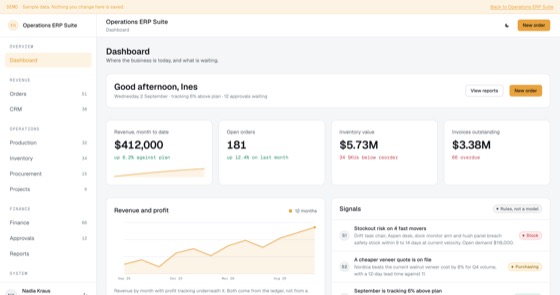
The full ERP spine: orders, CRM, production, stock, purchasing, projects, finance, approvals, reporting, people and automation.
5.0 out of 58 sold
OverviewEmployee1 / 6
5.0 out of 58 sold
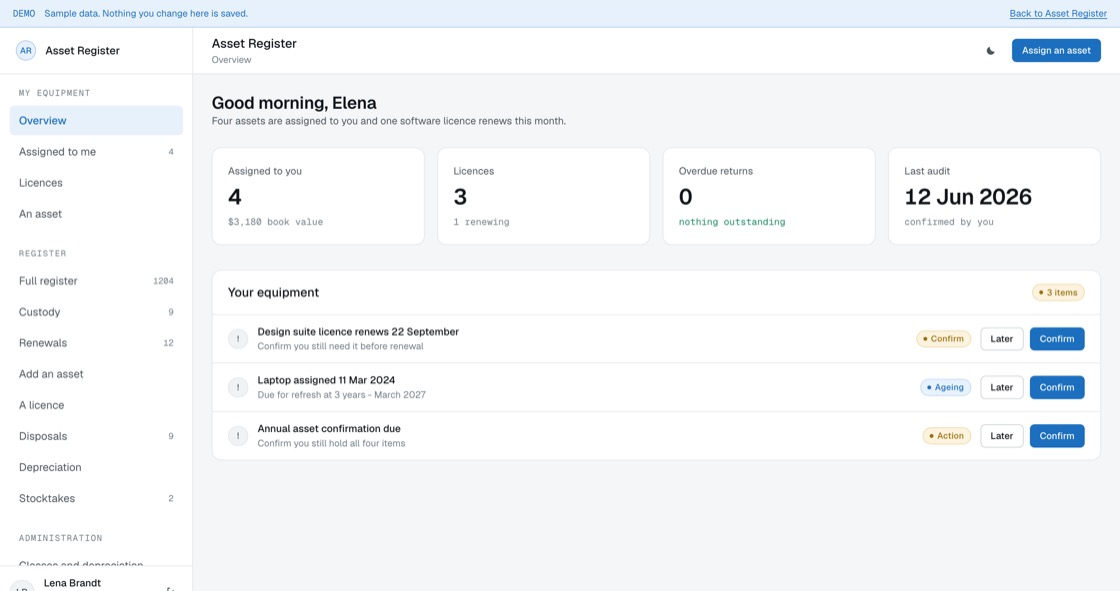
An asset register stops being a spreadsheet the moment someone leaves and nobody knows what they had. This tracks custody, cost and maintenance as one record per item.
From$569
Inside the app
23 connected functions on one schema, spanning three permission levels. Everything below is in the template before a line of customisation.
Four assets are assigned to you and one software licence renews this month.
What you hold, since when, and what happens when you leave.
Software assigned to you, and when it renews.
Every asset, who holds it, and what it is worth.
Who has had what, and every handover in between.
Warranties, licences and certifications counted down by date.
How each class is valued, and when it should be replaced.
Every assignment, transfer and disposal. Retained for seven years.
Permissions
An employee sees what they hold. An asset manager sees the register and custody. An administrator sets classes and depreciation. Signed custody is what turns a list into a record.
The build
9 screens, all of them live in the preview. Nothing on this list is a mockup or a roadmap item.
Access
My equipment
Register
Administration
What you get
IT, facilities and finance teams tracking equipment across offices, vehicles or sites.
Access and evidence
The value of an asset register is being able to say who accepted responsibility for something, on what date. That is precisely the question asked when equipment goes missing, and it is unanswerable without signatures.
Related
The full ERP spine: orders, CRM, production, stock, purchasing, projects, finance, approvals, reporting, people and automation.
5.0 out of 58 sold
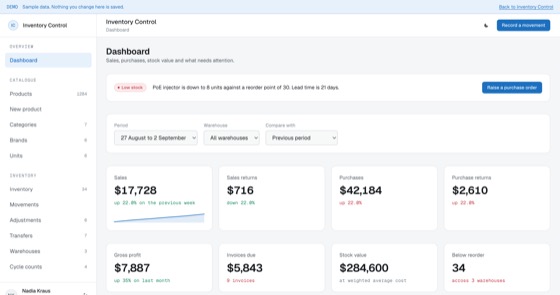
Catalogue, stock, warehouses, purchase orders, suppliers, sales, cycle counts and valuation, on one append-only movement ledger.
5.0 out of 510 sold
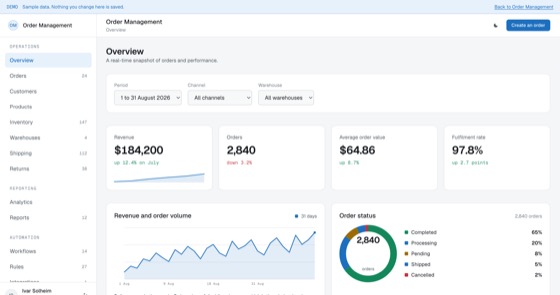
A full order management system: orders, customers, catalogue, stock, warehouses, shipping, returns, automation rules and integrations.
5.0 out of 510 sold
Questions
Not covered here?
Ask a consultant directly. No form to fill in first, and no follow-up sequence.
Book a consultantAll questionsYes. The repository, application code, database schema, migrations, seed data and deployment configuration, is transferred to your organisation on delivery.
This tells you what you own, what it cost and who holds it. Maintenance Manager tells you whether it will keep working, schedules, breakdowns and downtime. They pair naturally, and in a fitted build they share one asset record rather than duplicating it.
Yes, and it flags licences nobody has used for six months before they renew. Unused software is usually the easiest saving in an asset review and the one nobody looks for.
It maintains depreciation by class and produces a register that reconciles on any date. Posting depreciation into your ledger is an integration, Finance Ledger or your existing accounting package, set up in a fitted build.
That is the usual route. A fitted build sets up your asset classes, depreciation methods, tagging scheme, custody rules, barcode formats, branding and up to two integrations.
Hosting only, paid to your own cloud provider, roughly $50 to $200 a month.
Start here
A fitted build adjusts fields, stages, roles and integrations to how your team already works. One scoping call, a fixed price, one to three weeks.