Event ManagementLive
Event Booking
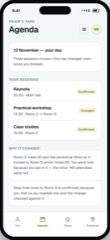
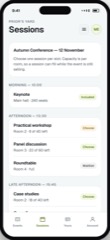
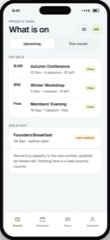
Events with sessions, capacity and pricing tiers, booked against real availability.
5.0 out of 59 sold
TicketsUser1 / 4
4.5 out of 56 sold
The ticket itself: issued to a person, transferable on your terms, refundable on your policy, and valid when the venue wifi is not.
From$799
Inside the app
22 connected functions on one schema across 2 user types. Everything below is in the template before a line of customisation.
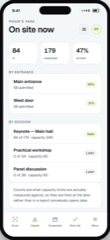
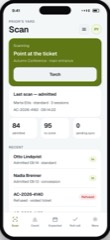
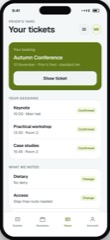
Every ticket on the phone and valid offline. A door queue does not wait for connectivity, and a flat battery is the holder’s problem you should still solve.
Issued to a person rather than to a code, which is what makes transfer controllable and touting harder.
To a named recipient on your rules, with the chain recorded. Blocking transfer entirely just moves it to a car park.
Against the policy you set, shown before purchase rather than discovered at the point of asking.
One ticket, individually, with a reason. A system where the only remedy is cancelling an order is a system that punishes the wrong person.
Issue, transfer, refund and void all recorded against the ticket. Disputes at a door are settled from a record rather than a memory.
User types
A ticket is a small contract. The holder needs it to work at a door with no signal, and the organiser needs to be able to void exactly one of them without touching the rest.
01User
2 of 4 screens
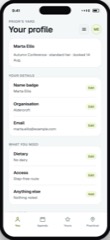
Holds their tickets, transfers one to a friend on your rules, and requests a refund without emailing anybody.
Preview as the user02Event owner
2 of 4 screens
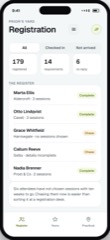
Controls issuance, transfer and refund policy, and can see and void an individual ticket when something goes wrong.
Preview as the event ownerThe limits
The same list we give for every app in the catalogue, because the fastest way to a bad project is a promise made in a meeting that nobody wrote down.
A ticketing platform’s fee partly buys discovery. This sells to people you can already reach.
Ticket money runs through your own payment provider account, which is what removes the per-ticket cut.
It transfers a ticket between named people. A secondary market with pricing and settlement is a much larger build with its own regulation.
Scanning works on standard phones. Turnstiles and access control are integrations we scope rather than assume.
Questions
If yours is not here, ask it on the call rather than guessing from a pricing page.
Not covered here?
Ask a consultant directly. No form to fill in first, and no follow-up sequence.
Book a consultantAll questionsYes. The ticket is held on the device and validated locally at the door. A venue with poor signal is the normal case, not the exception.
Usually yes, on your rules. Blocking transfer entirely does not stop it happening, it just moves it somewhere you cannot see or control.
Yes, individually and with a reason recorded. Cancelling a whole order to deal with one bad ticket punishes people who did nothing wrong.
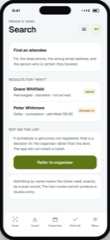
The door list holds the named attendee, so they can be found and admitted manually with the ticket marked used. That path exists because it always happens.
Yes. Both apps, API, schema, migrations and deployment configuration transfer on delivery.
Related
Events with sessions, capacity and pricing tiers, booked against real availability.
5.0 out of 59 sold
Scan at the door, valid once, working when the venue wifi does not.
The register, requirements and communication, for the people actually coming.
4.0 out of 53 sold
Start here
The preview is the real app with sample data. Open it and judge the software rather than the pitch.