What per-seat pricing actually costs a 40-person firm.
The licence comparison everyone runs is the wrong one. What matters is not this vendor against that vendor, it is a bill that grows every time you hire against one that does not move.
The arithmetic
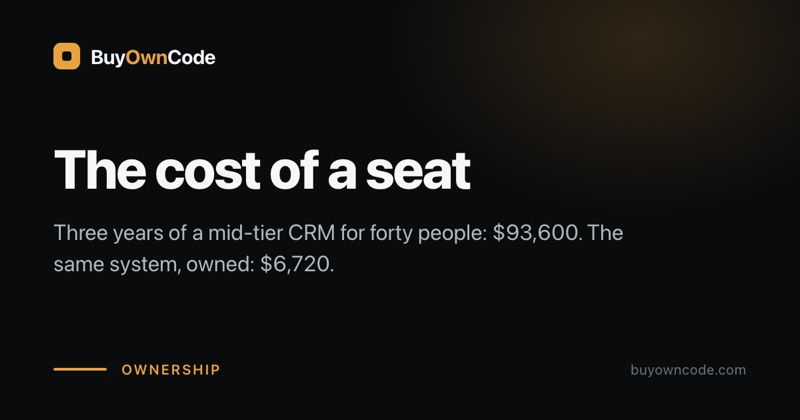
A mid-tier CRM seat is listed at $65 a user a month in 2026. For forty people that is $2,600 a month, $31,200 in year one, and $93,600 by the end of year three. Nothing in that number is unusual and nothing in it is disputed. It is what the rate card says, multiplied out.
| Year one | Three years | |
|---|---|---|
| Per-seat subscription | $31,200 | $93,600 |
| Owned, fitted build | $3,840 | $6,720 |
| Difference | $27,360 | $86,880 |
The owned figure is a fitted build from $2,400 plus self-hosting at $120 a month paid to your own cloud provider. Year one carries the build, years two and three carry hosting alone. You can set both numbers to your own team on the calculator in the numbers.
Why the gap is that wide
Because the two bills grow differently. The subscription is a function of headcount, so every hire raises it and no hire lowers it. The owned figure is a function of infrastructure, so it tracks how much you store and serve, which for an internal business system barely moves whether twelve people or two hundred are logged in.
One of these bills is indexed to your success and the other is not. Over three years that compounds into most of the gap above. Over five it stops being a line item and becomes a hire.
Where this comparison fails
At small headcounts. Five people on a project tool listed at $32 a seat spend $5,760 over three years, and the same system owned costs $6,720. At that size the subscription is cheaper and we would tell you so, which is what the calculator says when you set it there.
It also excludes implementation on both sides. Configuring a subscription product for how your team actually works is rarely free, and neither is shaping an owned one. We fix the second in writing before work starts, which is described in how it works.
The question worth asking
Not which product is better. Ask what your software bill looks like at the headcount you are planning for rather than the one you have. If you intend to grow, a per-seat licence is a tax on that plan. Browse what an owned version looks like in the catalogue, or read what the purchase actually transfers in what you own.
Read something similar
 Ownership
Where self-hosting costs you, and where it does not.
Owning the code moves some costs onto you. Here is an honest account of which ones, what they come to, and when renting really is the better answer. Buying
Template, fitted or custom: which one you actually need.
Three ways to buy the same source code. What separates them is how much shaping happens before it reaches you, and how to tell which one fits. Guide
Moving off a subscription without losing your history.
Export, mapping, parallel running and cutover: how a migration away from per-seat software actually runs, and which parts go wrong most often.
Start here
Run the numbers on your own team.
Set the calculator to your own team size, then tell us what you are replacing.
- No sign-up to open one
- One-time price, no seats
- Source code transferred on delivery