Property Manager
Tenancies, rent, repairs and safety certificates across a portfolio, with a tenant portal.
Next.js · TypeScript · PostgreSQL · Auth.js
Explore From $749
DashboardOwner1 / 12
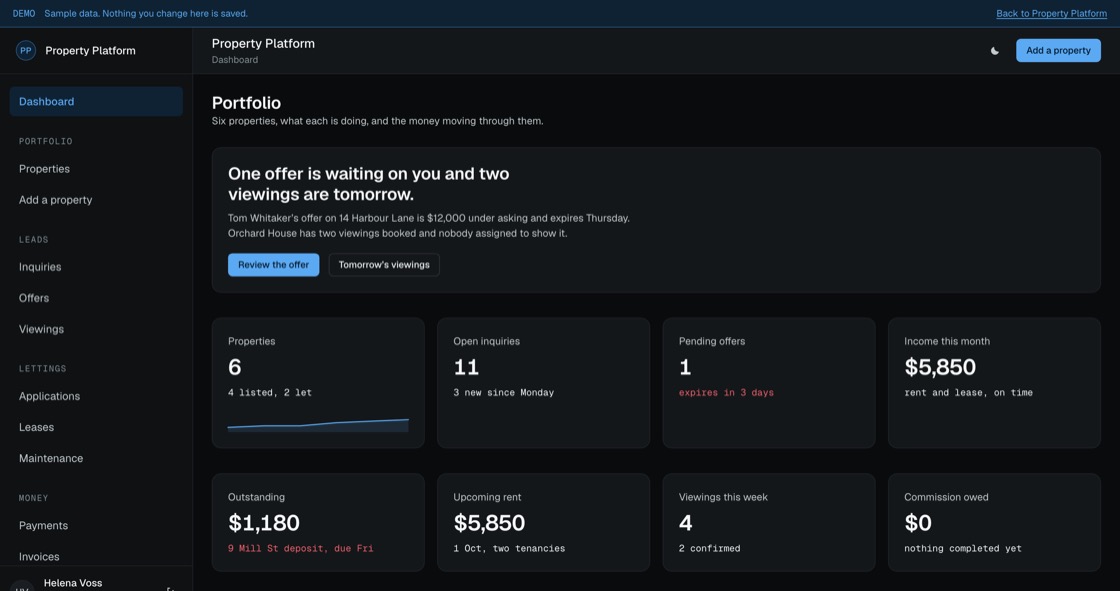
Most property platforms are a listings site with a contact form bolted on. This one carries the deal to the end: the offer, the deposit, the signed lease, the rent that follows and the commission it generates, on one record the owner, the agent and the buyer or tenant all see.
Next.js · TypeScript · PostgreSQL · Auth.js
Inside the app
28 connected functions on one schema, spanning five roles and the whole life of a deal. Everything below is in the template before a line of customisation.
A property carries its deal type, its price and its status through the whole cycle. The same record that was Available becomes Under offer, then Sold, or Rented, or Leased, and every inquiry, viewing, offer and payment along the way is attached to it.
A buyer submits an amount, terms and an expiry. The owner accepts, counters or asks for proof of funds, and the buyer answers from their own portal. The history is kept, so nobody argues later about what was offered when.
A rental application asks for income, employer, references and documents, and flags anything below the rent-to-income line the owner set. Approving it drafts the lease from the platform template with the terms already filled in.
Both parties sign in place. Each signature records who, when, from where and a hash of the document as signed. DocuSign and Adobe Sign are optional integrations, not requirements.
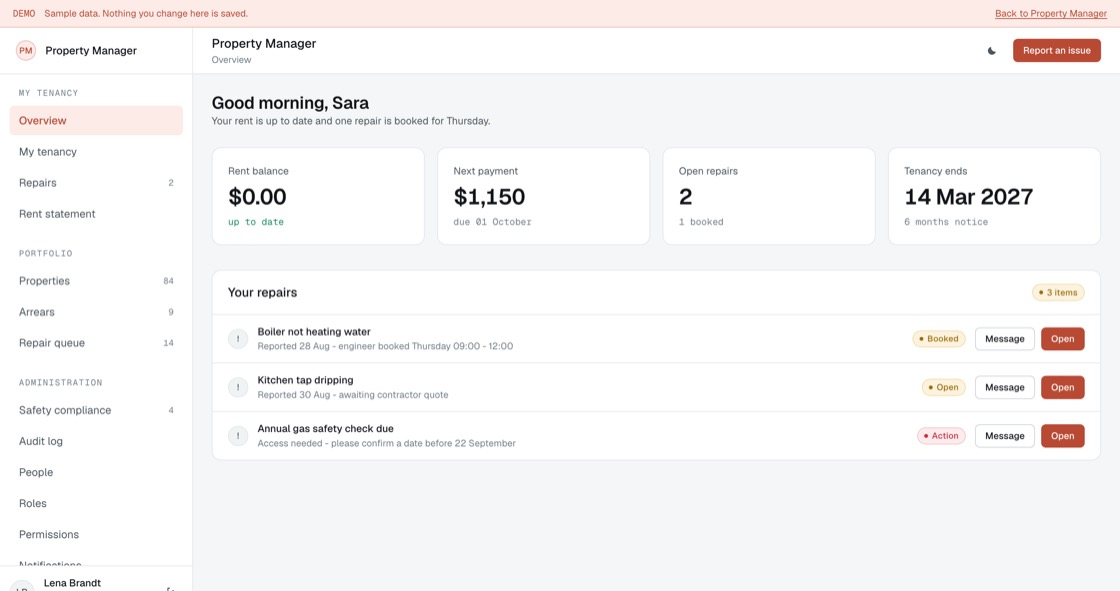
An invoice goes out before each due date, the tenant pays by card, transfer or wallet, and the owner sees paid, late or overdue against the schedule. Grace periods and late fees are terms on the lease, not settings someone has to remember.
Completed transaction, generated commission, admin approval, payment, paid. The agent sees the transaction amount, the rate, the deductions and the net, with the invoice, and the admin sees every rate override and who set it.
Permissions
Owners and agents run the portfolio; buyers, tenants and the platform each see exactly the slice that is theirs. The buyer and tenant portals are part of the application rather than a brochure site, which is why an offer, an application and a rent payment all land on the same record the owner is looking at.
The build
28 functions, all of them live in the preview. Nothing on this list is a mockup or a roadmap item.
What you get
Owners with a handful of properties, agencies that list for them, and the buyers and tenants on the other side.
Access and evidence
A property platform holds identity documents, income, signatures and money, on behalf of people who never meet. Who can read what, and what leaves the building, are structural here rather than a checklist someone signs at year end.
Related
Tenancies, rent, repairs and safety certificates across a portfolio, with a tenant portal.
Next.js · TypeScript · PostgreSQL · Auth.js

Listings with media, viewings and price history, published on your terms.
React Native · TypeScript · PostgreSQL · Expo
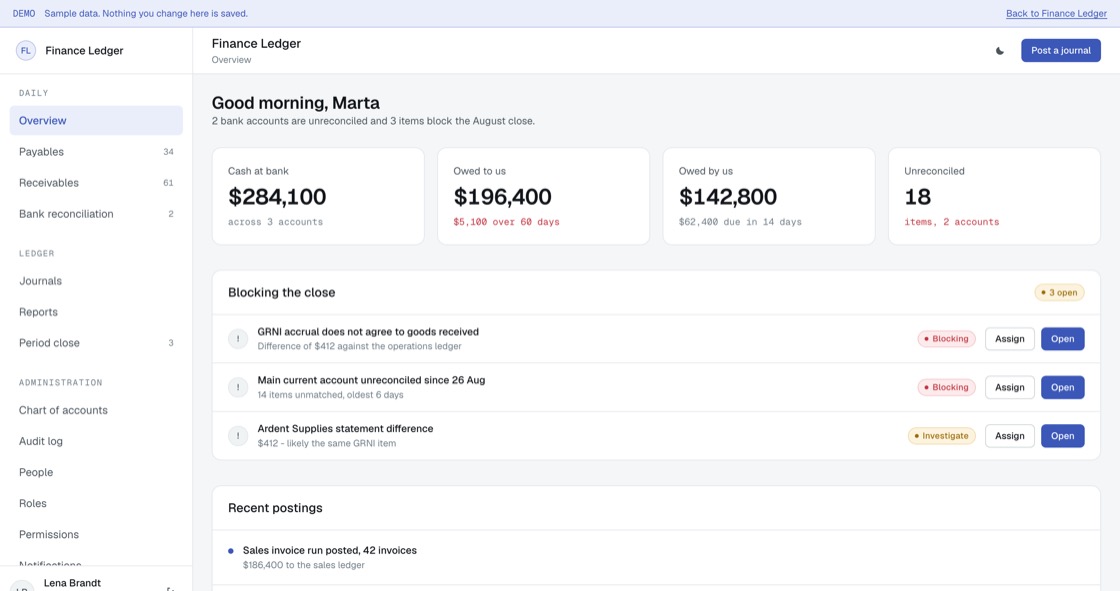
General ledger, payables, receivables and bank reconciliation on one double-entry schema.
Next.js · TypeScript · PostgreSQL · Recharts
Questions
Yes. The repository, application code, database schema, migrations, seed data and deployment configuration, is transferred to your organisation on delivery. There is no licence key and nothing that calls home.
As many as you like, on every side. Pricing is per application, not per user, so every owner, agent, buyer and tenant account exists at no extra cost.
Yes. Roles are per account, and an account can hold more than one. Someone who rents out a flat and rents another sees the owner side for the first and the tenant side for the second.
Stripe and PayPal out of the box, bank transfer with manual reconciliation, and a manual entry for anything paid outside the platform. Adding another gateway is one adapter.
Yes. A property is residential or commercial, and commercial units carry lease terms, square footage and business-tenant details rather than bedrooms and bathrooms.
Signing is built in and legally sufficient in most jurisdictions. DocuSign, Adobe Sign, Google Calendar and Outlook are optional integrations if you already run on them.
That is the fitted build. Fields, statuses, the sale and rental flows, commission rules and integrations are adjusted to your process on a fixed price after one scoping call.
A fitted build adjusts fields, stages, roles and integrations to how your team already works. One scoping call, a fixed price, one to three weeks.