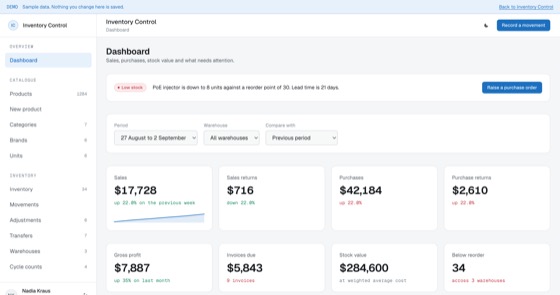
Inventory Control
Catalogue, stock, warehouses, purchase orders, suppliers, sales, cycle counts and valuation, on one append-only movement ledger.
5.0 out of 510 sold
TodayColleague1 / 6
4.5 out of 55 sold
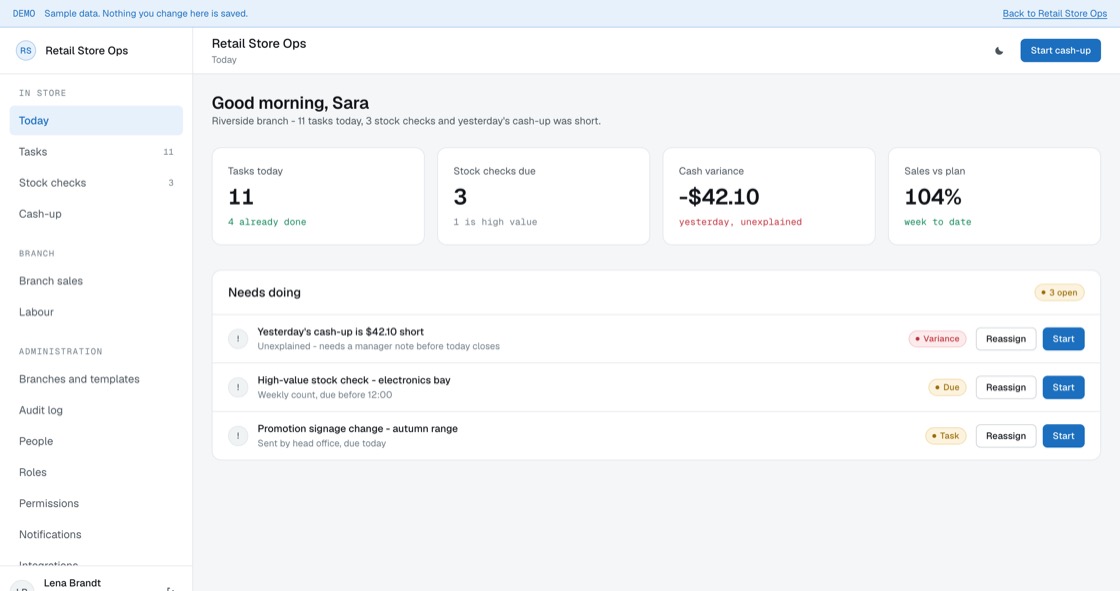
Head office sends tasks, stores do them, and nobody can prove either. This build gives each store one list, one cash-up and one stock check, and gives head office the answer without a phone call.
From$649
Inside the app
22 connected functions on one schema, spanning three permission levels. Everything below is in the template before a line of customisation.
Riverside branch - 11 tasks today, 3 stock checks and yesterday's cash-up was short.
What head office sent, what recurs daily, and who actually did it.
Counted blind, with variance that gets explained rather than absorbed.
Counted, declared and reconciled to the till. Variance needs a reason, not a shrug.
Against plan and against last year, by branch and by day part.
Hours scheduled against sales, so cover matches trade rather than habit.
Which tasks recur where, and what evidence each one needs.
Every variance, override and template change. Retained for seven years.
Permissions
A colleague sees one list for the day. A store manager sees the branch. An administrator pushes work to every branch at once. The point is that head office can prove what was asked and what was done.
The build
9 screens, all of them live in the preview. Nothing on this list is a mockup or a roadmap item.
Access
In store
Branch
Administration
What you get
Multi-site retailers and hospitality groups running 3 to 300 branches.
Access and evidence
Shrinkage rarely announces itself. It shows up as a cash-up that is quietly a little short, a stock check nobody counted properly, and a task marked done without evidence. Each of those has a control here.
Related
Catalogue, stock, warehouses, purchase orders, suppliers, sales, cycle counts and valuation, on one append-only movement ledger.
5.0 out of 510 sold
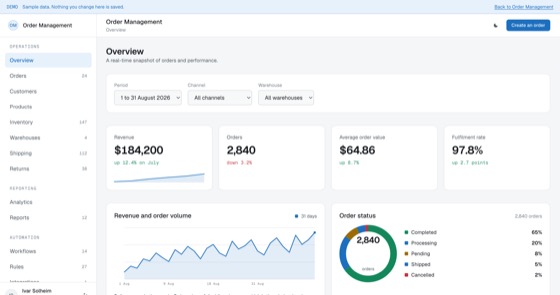
A full order management system: orders, customers, catalogue, stock, warehouses, shipping, returns, automation rules and integrations.
5.0 out of 510 sold
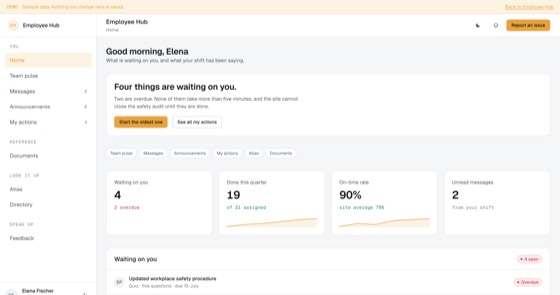
Announcements that require an action, tracked per employee, with reach reporting for managers.
4.5 out of 59 sold
Questions
Not covered here?
Ask a consultant directly. No form to fill in first, and no follow-up sequence.
Book a consultantAll questionsYes. The repository, application code, database schema, migrations, seed data and deployment configuration, is transferred to your organisation on delivery. There is no licence key and nothing that calls home.
As many as you like, pricing is per application, not per branch or per colleague, which is the usual way store systems become expensive as you open sites. Every colleague can have their own login, which is what makes the audit trail worth anything.
No, and that is deliberate. It reconciles to your till rather than replacing it. Point of sale is a specialist, hardware-bound problem with payment certification attached; a fitted build integrates your existing till so takings flow into the cash-up automatically.
That is the intended device. The colleague screens are built for touch and work offline, because stockrooms and back offices are exactly where the signal drops.
That is the usual route. A fitted build sets up your branch structure, task templates, evidence rules, variance thresholds, till integration, branding and up to two integrations, and typically takes one to three weeks from a signed scope.
Hosting only, paid to your own cloud provider, roughly $50 to $200 a month, rising with branch count and how much photo evidence you retain.
Start here
A fitted build adjusts fields, stages, roles and integrations to how your team already works. One scoping call, a fixed price, one to three weeks.